
 العربية
 Русский
 اردو
اردو
 中文
中文
 Français
UAE Celebrates World Environment Day 2026
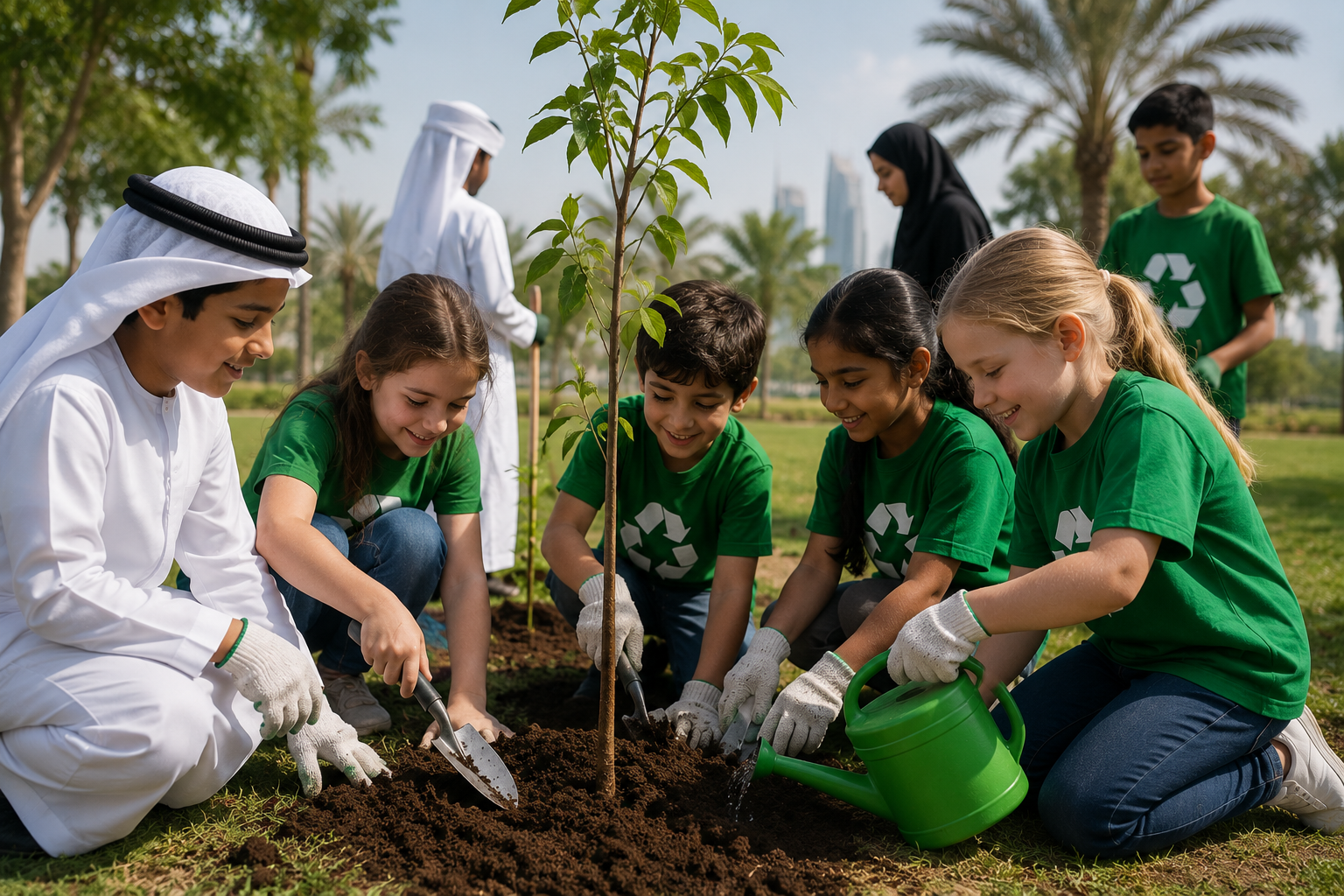
The United Arab Emirates celebrates World Environment Day on June 5, 2026, this year under the theme "Inspired by Nature. For Climate. For Our Future," reaffirming its strong commitment to achieving climate neutrality by 2050, within a comprehensive legislative and strategic framework that establishes its position as a global model for environmental sustainability.
UAE ranks first regionally in environmental performance.
His Highness Sheikh Hamdan bin Zayed Al Nahyan, the Ruler's Representative in the Al Dhafra Region and Chairman of the Environment Agency - Abu Dhabi, emphasized that addressing climate change requires the integration of roles among institutions, society, and individuals, calling for the enhancement of scientific research and the dissemination of environmental culture, noting that the vision of the late Sheikh Zayed bin Sultan Al Nahyan established a civilizational approach that made nature protection an integral part of the country's development journey.
The UAE leads international environmental performance indicators, ranking first regionally, Arabically, and Gulf-wide in the 2024 Environmental Performance Index, as well as being globally at the forefront in the Marine Protection Strictness Index and the Sewage Treatment and Reuse Index, making it the first in the Middle East to announce a climate neutrality goal by 2050 and commit to the Paris Agreement.
55 Nature Reserves and New Decree in Sharjah.
The seventh national report on biodiversity, approved by the Cabinet in March 2026, revealed an increase in the number of approved reserves to 55 terrestrial and marine reserves, covering 19.04% of the total area of the country. Last April, a royal decree was issued to establish the "Wadi Al-Qarha" reserve in the Emirate of Sharjah, adding a new qualitative addition to the network of national reserves.
The report highlighted significant progress in protecting endangered species through integrated breeding programs, habitat management, and international cooperation. Coastal and marine systems also experienced a qualitative leap through the national blue carbon project, which aims to plant 100 million mangrove trees by 2030.
The UAE issued a new law to regulate and monitor international trade in endangered animals and plants, while launching an international initiative through the Mohammed bin Zayed Fund for Conservation of Living Organisms to protect manatees and seagrass habitats in the UAE and four other countries.
Quality initiatives in Abu Dhabi, Dubai, and Sharjah
The Environment Agency – Abu Dhabi launched the "Hamdan bin Zayed for the Richest Seas in the World" initiative, aiming to double the fish stock in the emirate by 2030. In contrast, Dubai approved the "Al Liwan Oasis" project, covering one million square meters and featuring a natural lake, as a model for the compatibility between urban development and environmental sustainability. Meanwhile, Sharjah's Environment and Natural Reserves Authority recorded the discovery of four new spider species, reflecting the depth of biodiversity and scientific rigor in the country.
In terms of combating plastic pollution, the Environment Agency – Abu Dhabi revealed remarkable results since the implementation of the single-use plastics policy in 2020, notably avoiding the use of over 470 million plastic bags, with a recorded reduction of 95% in major retail outlets.
Climate-smart agriculture and global water security
The Ministry of Climate Change and Environment, in collaboration with the International Center for Biosaline Agriculture "ICBA", announced the launch of the "National Agricultural Initiative for Adopting Climate-Smart Crops", which relies on four strategic crops, primarily millet and sorghum, as they consume up to 50% less water compared to traditional grains, making them a practical solution amid water scarcity challenges.
The UAE continues to lead the global water security agenda through the "Mohammed bin Zayed Water Initiative", the "UAE Water Foundation", and the Abu Dhabi Global Water Platform. The country is preparing to host the "United Nations Water Conference" in December 2026 in partnership with the Republic of Senegal, which is an additional confirmation of its pivotal role in supporting the implementation of the UN Sustainable Development Goals.
Does your organization need to review its commitments in light of the evolving UAE environmental legislation?
Team Awad Al-Muhairi Law Office and Legal ConsultationsFully prepared to provide specialized legal advice in the field of environmental compliance and green legislation in the United Arab Emirates.
Legal Comment — Awad Al-Muhairi Law Office and Legal Consultations
The environmental landscape of the UAE in 2026 reflects a fundamental shift in the concept of sustainability; environmental protection is no longer an optional matter or an awareness framework, but has become a mandatory legislative system that includes federal and local laws criminalizing harm to the environment and imposing legal responsibility on individuals and institutions alike.
In light of the increasing role of environmental regulatory bodies and the expansion of green legislation, environmental compliance has become a necessary legal requirement, especially in the sectors of industry, construction, transportation, and food. The UAE thus embodies a model that proves that a robust legal framework is the true guarantee for the sustainability of environmental achievements across generations.