
 العربية
 Русский
 اردو
 中文
 Français

Criminal Defense
Cyber Defamation in UAE: Penalties and Rights Protection
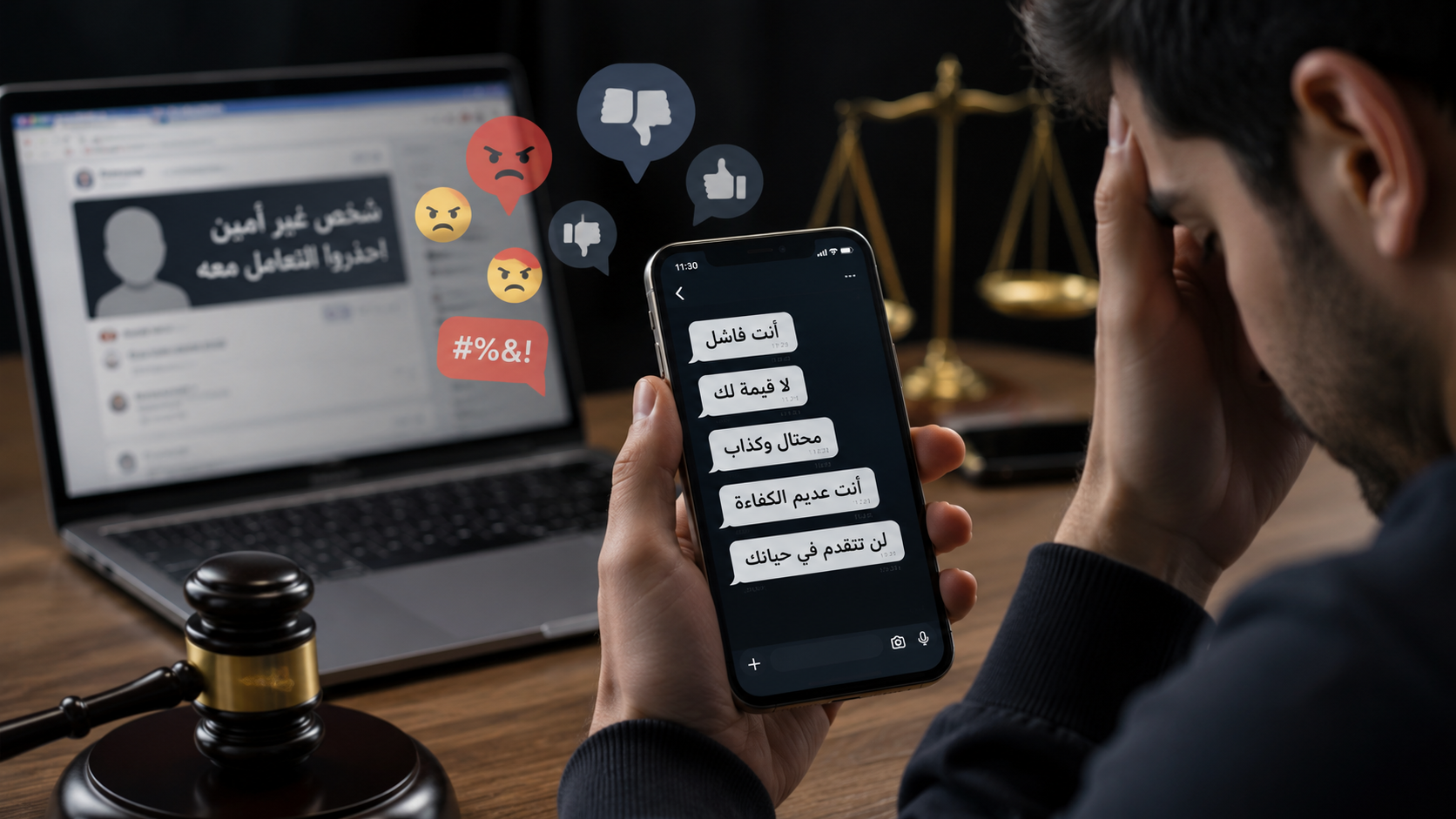
Electronic insult and defamation in the UAE, together with swearing at or insulting someone face to face or over the phone, are crimes punishable by imprisonment or a fine, and the fine for insulting someone through an information network or any information technology means ranges from AED 250,000 to AED 500,000. The penalty varies widely depending on the means used, whether the words were said publicly or in a private message, whether they accused the person of a specific act, and who the target was. As a rule, the case can only proceed on a complaint by the victim filed within three months of learning of the crime and its perpetrator.
Social media and messaging apps have become an arena for crimes the law punishes strictly, chief among them electronic insult and defamation. A single word in a WhatsApp group or a comment on Instagram can lead to a criminal complaint, imprisonment and a fine. UAE law addresses this through Federal Decree-Law No. (34) of 2021 on Combating Rumours and Cybercrimes and Federal Decree-Law No. (31) of 2021 Promulgating the Crimes and Penalties Law.
In this article, our team sets out what you need to know whether you are the victim or fear being accused, whether the insult happened in the street, at work, over the phone or on social media. Many of these files start with an angry message and end in a criminal case, or in a complaint that is shelved because of a mistake in timing or evidence.
Legal review: Advocate Awadh Almheiri, registered with the Legal Affairs Department of the Government of Dubai under No. 557. Last updated: 16 October 2026.

What Is the Difference Between Insult and Defamation Under UAE Law?
The distinction determines the applicable provision, the penalty and the line of defence, and it is the first thing a lawyer examines.
Electronic insult
Definition: directing words or expressions that offend a person or degrade their dignity through an electronic means. Example: sending a message containing a swear word or a demeaning description.
Electronic defamation
Definition: attributing a specific fact to a person that would expose them to punishment or contempt. Example: publishing an accusation of theft or dishonesty without evidence.
The same rule governs traditional insults and swearing: insult means attacking someone's honour or standing without attributing a specific fact, while defamation means attributing a specific fact to them. Calling someone a thief in front of others without referring to a particular incident is most likely an insult, whereas saying he stole the cash box money last month is defamation. Insult is therefore not defamation, although the two sometimes appear in the same sentence.
Penalty for Swearing at or Insulting Someone Face to Face in the UAE
Swearing at someone in the street, at work, in front of neighbours or during a verbal argument is punishable under the Crimes and Penalties Law as follows:
Public insult
Imprisonment of up to one year or a fine of up to AED 20,000 for anyone who publicly insults another person in a way that harms their honour or standing.
Public defamation
Imprisonment of up to two years or a fine of up to AED 20,000 for anyone who publicly attributes to another person a fact that would expose them to punishment or contempt.
Insult to the victim's face in the presence of others, or over the phone
Imprisonment of up to 6 months or a fine of up to AED 5,000.
Insult to the victim's face with no one else present, or in a message
A fine of up to AED 5,000. This is the penalty for swearing without witnesses, and the real difficulty lies in proof rather than in the penalty.
What people call verbal abuse usually falls under these descriptions, unless it is accompanied by a threat, which is governed by the separate threat provisions with their own penalties. As for Article 374 of the UAE Penal Code, which many people still search for, that number belongs to the repealed 1987 Penal Code; today the insult and defamation provisions are Articles 425 to 427 of the 2021 Crimes and Penalties Law.
Where Electronic Insult and Defamation Can Occur
Electronic insult and defamation offences cover any information technology means, including:
WhatsApp (private messages or groups).
X (formerly Twitter), Instagram, Facebook and TikTok.
Email and text messages.
Forums, websites and article comments.
Encrypted apps and other chat applications.
Penalty for Electronic Insult and Defamation in the UAE
UAE law distinguishes between insults in a private space and in a public space, a fundamental distinction that affects the legal description and the severity of the penalty.
Insult on a public platform or open information network
Applicable law: the Law on Combating Rumours and Cybercrimes. Penalty: imprisonment and a fine of not less than AED 250,000 and not more than AED 500,000, or either penalty.
Insult via WhatsApp (private chat or limited group)
Applicable law: a matter of legal characterisation between the messages provision of the Crimes and Penalties Law and the provision on insult through an information technology means in the Cybercrimes Law. Penalty: from a fine of up to AED 5,000 up to the cybercrime penalty, depending on the description adopted by the Public Prosecution and the court.
Insulting a public official during or because of their work
Applicable law: the Crimes and Penalties Law and the Cybercrimes Law. Penalty: an aggravating circumstance that increases the penalty.
When Is the Penalty for Insult Aggravated? Can a Foreigner Be Deported?
Aggravating circumstances include insult or defamation against a public official or a person entrusted with a public service during or because of their work, words that touch on a person's honour or harm the reputation of families, an intent to achieve an unlawful purpose, or publication in newspapers or printed matter. For aggravated public insult, the penalty becomes imprisonment of up to two years and a fine of AED 20,000 to AED 50,000, or either penalty.
As for deportation, when a court sentences a foreigner to a custodial penalty for a misdemeanour, it may order deportation from the country or impose deportation instead of imprisonment, unless at the time of the offence the person was the spouse or a first-degree relative of a UAE national. This is what turns a seemingly minor insult case into a real risk to a resident's visa and job, and why a lawyer should be present from the first summons.
How Is Insult or Defamation Proven?
Investigators and courts rely on digital evidence, most notably:
Screenshots documented with date and time.
Complete copies of chats or messages without cropping.
Technical reports issued by technical investigation authorities.
Public links and posts that can be officially documented.
Testimony of those present, for face-to-face insults.
Evidence extracted from devices and information technology means carries the weight of physical criminal evidence under the Law on Combating Rumours and Cybercrimes, but its value depends on how soundly it was extracted and on linking the account or number to the accused.
How Do I File an Insult Complaint in Dubai?
The complaint is submitted to the Public Prosecution or to a judicial officer, which in practice means a police station or Dubai Police's digital channels, including the platform for reporting cybercrimes. But a complaint written in a hurry, with the wrong description or without preserved evidence, is often shelved. That is why your file goes through the following stages with us:
Documentation
Preserve the evidence before it is lost
We identify which messages, posts and witnesses must be preserved, and how to preserve them without losing their value.
Characterisation
Determine the correct legal description
Insult or defamation, public or private, the Crimes and Penalties Law or the Cybercrimes Law: the description governs the penalty and the compensation.
Complaint
File it on time
We draft the complaint and file it within the three-month deadline, with a civil claim for compensation where needed.
Litigation
Follow through to the end
We follow the investigation and the trial, or negotiate a settlement that protects your rights.
Summoned Over an Insult or Defamation Complaint? What to Do
Many insult cases start with a message in a work group, an angry review or a reply to an earlier insult. The first mistake an accused person makes is to contact the complainant to apologise or to threaten, or to delete their account thinking this ends the case; both can be used against them.
Grounds for acquittal in insult and defamation cases that a lawyer examines include: a complaint filed more than three months after the victim learned of the crime and its perpetrator, the absence of publicity or of the means on which the charge rests, failure to prove that the account or number belongs to the accused, statements made by litigants before courts and investigators within the limits of the right of defence, good-faith reporting to judicial or administrative authorities, and proof of the truth of a fact attributed to a public official where it relates to their position. Which of these defences fits your file requires reading the papers.
Settlement and Withdrawal in Insult and Defamation Cases
The complainant may withdraw the complaint at any time before a final judgment, which ends the criminal case, and if the withdrawal comes after the judgment has become final, the Public Prosecution stops enforcement of the penalty. Criminal reconciliation is permitted in insult and defamation even after the judgment becomes final, and in electronic insult and defamation it may be recorded before the judgment becomes final.
Before referral to court, the Public Prosecution may refer the parties to criminal mediation. Reconciliation does not affect the victim's right to civil compensation unless they waive it or the settlement covers it, which is why drafting the settlement agreement is a legal matter that should not be left to the parties alone.
Insult and Defamation Cases Before the Dubai Courts
In Dubai, insult and defamation complaints are filed with Dubai Police, the Dubai Public Prosecution investigates and decides on them, and the Dubai criminal courts hear the case. AWADH ALMHEIRI LAW FIRM AND LEGAL CONSULTATIONS handles insult, swearing and electronic defamation cases for complainants and defendants alike, from the complaint or summons through to settlement or judgment. If you are looking for an insult and defamation lawyer in Dubai, bring the messages and facts to our office before any contact with the other party.
Legal Deadlines in Insult and Defamation Cases
3
months
The deadline for filing the complaint from the day the victim learns of the crime and its perpetrator; it is not accepted afterwards.
1
month
The maximum duration of criminal mediation, renewable once.
5
years
The truth of a fact attributed to a public official cannot be proven if more than five years have passed since it occurred.
Five Practical Steps If You Are Insulted Online
Document the evidence immediately
Keep screenshots and complete messages without deleting anything.
Do not respond in kind
Replying with similar abuse exposes you to legal liability.
Do not repost
Republishing the offensive content may create separate liability for you.
Report promptly
Remember that the complaint is not accepted more than three months after you learn of the crime and its perpetrator.
Consult a lawyer
To assess the facts and determine the correct legal description and the appropriate procedures.
Legal References
Federal Decree-Law No. 31 of 2021 Promulgating the Crimes and Penalties Law, as amended.
Federal Decree-Law No. 34 of 2021 on Combating Rumours and Cybercrimes, as amended.
Federal Decree-Law No. 38 of 2022 Promulgating the Criminal Procedure Law, as amended.
Frequently Asked Questions About Insult, Swearing and Defamation in the UAE
Dubai
AWADH ALMHEIRI LAW FIRM AND LEGAL CONSULTATIONS in Dubai handles insult, swearing, electronic defamation and WhatsApp insult cases before Dubai Police, the Dubai Public Prosecution and the Dubai Courts, covering complaints, defence, settlement and compensation.
Other Emirates
The firm also handles insult, defamation and cybercrime cases in Abu Dhabi, Sharjah, Ajman, Umm Al Quwain, Ras Al Khaimah and Fujairah, as it is registered in Dubai and with the Ministry of Justice and appears before all courts in the UAE.