
 العربية
 Русский
 اردو
اردو
 中文
中文
 Français

Labor Law
Is Completing a Blank Signed Check by the Beneficiary Forgery?
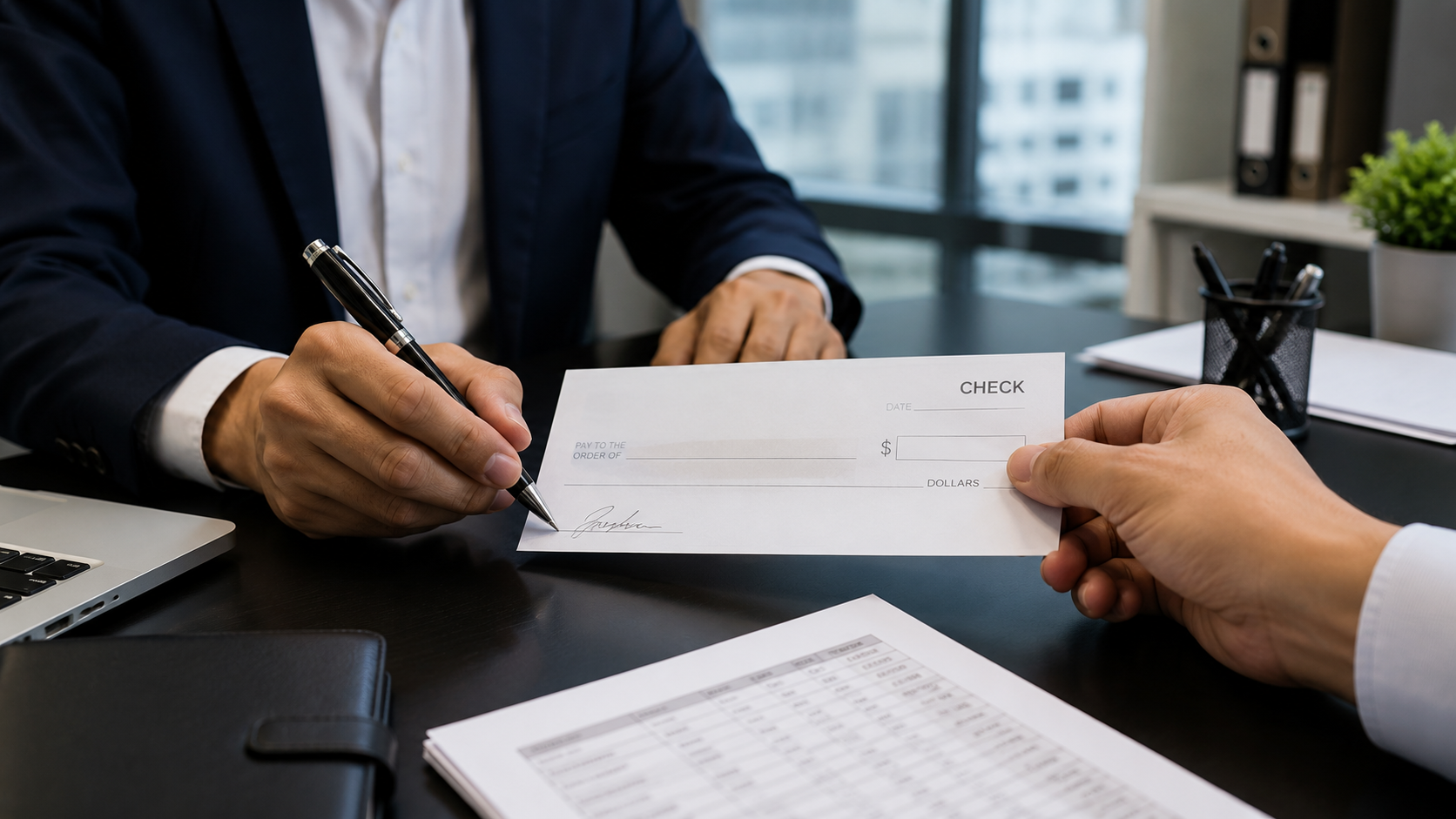
Cheques are among the most widely used instruments of payment in commercial and economic life in the UAE, relied upon by individuals and companies alike to settle financial obligations, repay debts, and carry out transactions of every kind. Among the matters that most provoke debate among dealers is the subject of blank signed cheques — and whether the payee's completion of their data after receiving them from the drawer constitutes the crime of forgery or not. This issue arises repeatedly in commercial and civil disputes, and even in some criminal complaints, particularly in construction, supply, partnership, financing, and guarantee contracts. In this article we review the provisions regulating the cheque, the concept of the blank signed cheque, and the difference between completing the data and altering it, in light of the Commercial Transactions Law and settled judicial principles.
Is Filling In a Blank Signed Cheque by the Payee Considered Forgery?
First: What Is a Cheque Under UAE Law?
The Commercial Transactions Law has defined a cheque as a commercial paper containing an order issued by the drawer to the drawee bank to pay, on the day stated therein as the date of its issuance, a specified sum of money to the order of a third party who is the payee, or to its bearer.
" A cheque is a commercial paper containing an order issued by the drawer to the drawee bank to pay, on the day stated therein as the date of its issuance, a specified sum of money to the order of a third party who is the payee, or to its bearer.
It is clear from this definition that a cheque is founded on three principal parties:
1
The drawer
2
The drawee (the bank)
3
The payee
The law also affirms that a cheque is an instrument of payment, not of credit, and falls due for payment merely upon its presentation in accordance with the prescribed provisions. For this reason the UAE legislator has granted it a special status among commercial papers and laid down detailed provisions relating to its creation, circulation, payment, and the claiming of its value.
Second: The Importance of the Signature on a Cheque
The signature is the essential pillar on which the commercial paper rests; it is among the most important mandatory particulars of a cheque, and its absence leads to the non-existence of the cheque and the failure of any legal effect for it. It follows that the signature is the legal expression of the drawer's will, is what creates his obligation, and is the basis on which all other particulars rest.
Here the importance of distinguishing between two legally fundamental situations becomes apparent:
Third: What Is Meant by a Blank Signed Cheque?
A blank signed cheque means that the drawer signs the cheque while leaving some data blank to be completed later. Among its most common forms: signing the cheque and leaving the amount blank, leaving the date blank, or leaving the payee's name unwritten.
This practice is widespread in many commercial relationships, including:
Construction contracts.
Supply agreements.
Commercial partnerships.
Financing transactions.
Contractual guarantees.
The aim is often to grant the other party the possibility of completing the data upon the fulfilment of certain conditions or upon determining the final sums due.
Fourth: The Settled Judicial Principle on the Blank Cheque
UAE jurisprudence has settled on an important principle in dealing with blank signed cheques, to the effect that signing a cheque in blank and delivering it to the payee indicates, on its face, the authorization of the payee to complete the missing data, and that signing a cheque in blank without inserting its value or date does not affect the validity of its issuance.
" Signing a cheque in blank, without inserting its value or date, does not affect the validity of its issuance, and indicates the authorization of the payee to supply what is missing of the data before presenting it for payment.
It follows from this principle that the payee's mere writing of the missing data after receiving the cheque signed by the drawer is not, by itself, sufficient to assert the existence of forgery.
Fifth: Why Is Filling In the Data of a Blank Cheque Not Forgery in Principle?
To answer this question, one must start from a basic point: it is the drawer who signed the cheque of his own will, delivered it to the payee, and enabled him to possess the commercial paper. Accordingly, the payee's completion of the missing data does not automatically mean that he has changed the truth; rather, the principle adopted by the judiciary is that delivery in blank indicates the existence of an implied or apparent authorization to complete the data.
The Core Rule
Merely writing the amount, the date, or some of the missing data on a cheque bearing a valid signature and delivered by the drawer's will does not, in itself, constitute the crime of forgery.
Sixth: The Difference Between Completing Data and Alteration
Here lies the most important legal point, for one must distinguish precisely between completing the missing data and alteration, since each has its own nature and different effects:
Seventh: Is a Difference in Handwriting Evidence of Forgery?
Among the most frequent defences raised in practice is the claim that "the amount is written in a different hand from the signature," or that "the date is not in the drawer's handwriting." Yet this defence alone is not sufficient to prove forgery, because a blank signed cheque by its very nature may contain data written in the hand of someone other than the drawer. Therefore, a difference in handwriting is not conclusive evidence of forgery so long as the signature is valid and issued by the drawer himself.
Eighth: The Burden of Proof in Blank Cheque Disputes
When the drawer alleges that the payee exceeded the limits of the authorization, the burden of proof becomes a fundamental matter. The principle settled by the judiciary is the validity of the cheque signed by the drawer; whoever alleges otherwise must produce the evidence supporting his claim. Accordingly, a mere allegation that the amount was not agreed upon is not by itself sufficient to reach a particular legal conclusion without producing the supporting evidence and documents.
Ninth: An Important Warning — A Blank Cheque Does Not Shield from Criminal Liability
It is essential to note that the foregoing judicial principle does not mean that signing a cheque in blank exempts the drawer from liability. UAE jurisprudence has affirmed that delivering the cheque to the payee puts it into circulation and brings legal protection to bear upon it, and that the liability arising from issuing a cheque without existing, withdrawable funds is not extinguished by the plea that the cheque was delivered in blank.
Beware This Misconception
Signing a cheque in blank and delivering it is not a means of safety for the drawer, as he remains liable for the cheque the moment it is put into circulation. Therefore, issuing a blank cheque without sufficient funds remains a matter fraught with legal risk for the drawer himself.
Tenth: Common Practical Examples
First example: A contractor delivers the supplier a signed cheque and leaves the amount field blank until the works are completed, and the supplier later inserts the final sum due. Here, merely writing the amount is not sufficient to assert the existence of forgery.
Second example: A partner delivers his partner a blank cheque as a guarantee for performing an obligation, then the two differ over the amount. Here the dispute relates to the limits of the authorization and the agreement, not to a mere difference in handwriting or the writing of data.
Third example: A company delivers a supplier a signed cheque leaving the date blank to be used upon maturity, and the supplier inserts the date and presents the cheque. This is a common form that does not, in itself, mean that forgery has occurred.
Eleventh: Common Mistakes to Avoid
Delivering blank cheques unnecessarily
Avoid delivering a blank signed cheque unless there is a genuine need, and complete its data before delivery wherever possible.
Keeping no evidence of the purpose
Always keep proof of the purpose of the cheque and the agreed amount, and a copy of the cheque before delivering it.
Relying on oral agreements
Document the agreement relating to the cheque in writing, as an oral agreement is difficult to prove in a dispute.
Leaving all the data blank together
Leaving the amount, date, and payee's name blank at the same time widens the limits of authorization and increases the risk.
Frequently Asked Questions on the Blank Signed Cheque
Conclusion
It is clear that the payee's mere filling in of the missing data on a blank signed cheque does not, in itself, constitute the crime of forgery so long as the drawer signed the cheque and delivered it of his own will, since the judiciary has settled that delivery in blank indicates, on its face, the authorization of the payee to complete the data before presenting it for payment. On the other hand, one must distinguish between completing the missing data and changing or altering existing data, for each situation has its circumstances and effects. The drawer also remains liable for the cheque the moment it is put into circulation, so signing in blank is not a shield that protects him from liability. Disputes relating to exceeding the limits of authorization or misusing the cheque fall under the authority of the competent court in light of the evidence produced in each case.
Legal References
- Federal Decree-Law No. (50) of 2022 on the Issuance of the Commercial Transactions Law — (Decree-Law).
- The settled judicial principles of the Federal Supreme Court on the blank signed cheque and the authorization to complete its data.
- The book "Provisions of the Cheque in the Commercial Transactions Law" issued by the Legal Affairs Department of the Government of Dubai.
Legal Disclaimer
This material is for general legal awareness purposes only and does not constitute legal advice or a final legal opinion. Legal outcomes differ according to the circumstances of each case, the evidence produced therein, and what the competent court concludes. Please obtain specialized legal advice suited to your situation before taking any action. In the event of any discrepancy in translation, the Arabic text shall prevail as the authoritative reference.
Related Articles