
 العربية
 Русский
 اردو
اردو
 中文
中文
 Français

Family Law
Customary Marriage in the UAE: Is it Legal and How is it Proven?
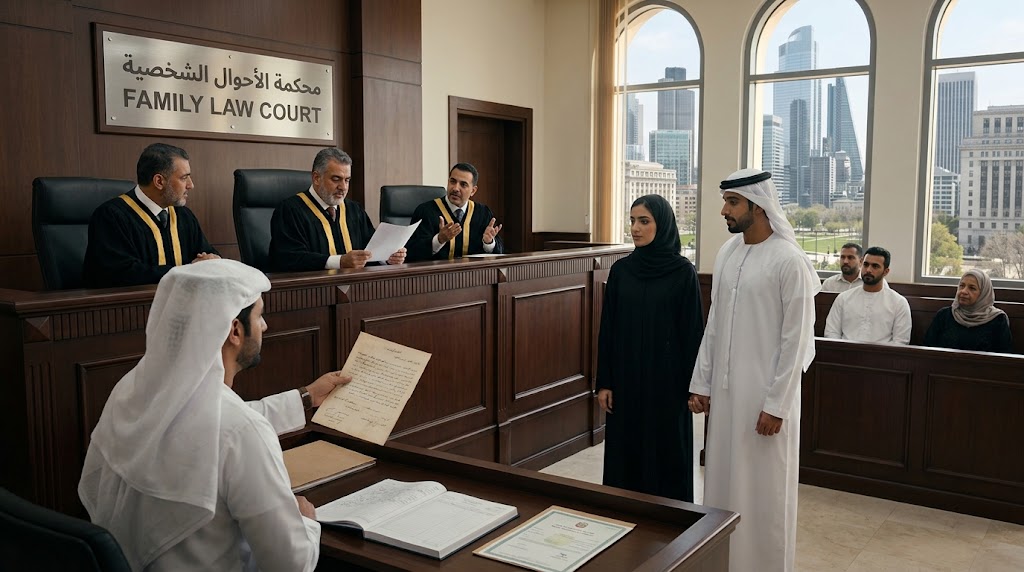
Customary (urfi) marriage in the UAE is not a single thing. The law requires marriage contracts to be documented in court, but it distinguishes between a contract that meets all its pillars and conditions and was simply never documented, which is a valid marriage that can be proven before the court, and an arrangement that lacks the guardian, the witnesses or another condition of validity, which is an invalid contract with only limited effects. Confusing the two is the most dangerous mistake people make, because many discover at the first dispute, divorce or birth that what they thought was a marriage does not protect them as they expected.
The wife and children remain the parties most exposed in an undocumented marriage: maintenance that cannot be claimed until the marriage is proven, conditions agreed orally that count for nothing if denied, a divorce that may be sent by message and never documented, and children who need a judgment to prove their parentage and obtain their papers.
In this article the team at AWADH ALMHEIRI LAW FIRM AND LEGAL CONSULTATIONS explains the difference between customary marriage, the valid but undocumented marriage and the official marriage, whether customary marriage is legal in the UAE, the truth about the penalty for customary marriage, the pillars the court examines, the risks, how such a marriage is proven in court, its effect on divorce and parentage, and the firm's role at each stage. You will find all articles in this field on the Family Law category page.

Customary, Religiously Valid and Official Marriage: What Is the Difference?
People use the word "customary" for any marriage not documented in court, but the law distinguishes three very different situations:
Customary Marriage (Defective)
An arrangement between a man and a woman that lacks a pillar or a condition of validity, such as the absence of the guardian where the law requires one, the absence of two witnesses, or a secret contract nobody knows about. By law this is an invalid contract, and it is the most dangerous type for the woman and the children.
Valid but Undocumented Marriage
A contract that meets all its pillars and conditions: offer and acceptance, a guardian, two witnesses, the wife's consent and no impediments, but which was not documented in court. It is a valid marriage with effects from the moment it was concluded, but in practice those effects are only protected once it is proven in court.
Official Marriage
A contract documented in court or before a licensed marriage officiant, with an official certificate proving the marriage and its conditions, so its effects apply directly before every authority without any lawsuit.
Is Customary Marriage Legal in the UAE?
Article (41) of Federal Decree-Law No. 41 of 2024 issuing the Personal Status Law requires marriage contracts to be documented in court, while allowing any interested party to request proof of an undocumented marriage contract. In other words, failing to document is a breach of a legal duty, but it does not in itself void a contract that meets its pillars and conditions: a valid contract produces its effects from the moment it is concluded.
The practical difference, however, is huge. A wife in a documented marriage holds a certificate; in an undocumented one she must first prove the marriage before claiming any right. The law is also explicit that, if denied, no condition in a marriage contract counts unless it is written into the documented contract. So a condition on separate housing, work or anything else, if agreed only orally, may be lost the moment the husband denies it.
The Penalty for Customary Marriage in the UAE: What Does the Law Actually Say?
Much is said about the penalty for customary marriage in the UAE, and most of it confuses failing to document a marriage with a relationship outside marriage. The difference between the two is the difference between a claim to prove a marriage before the personal status court and a criminal case. These are the most common misconceptions and what the law actually says:
"The penalty for customary marriage is prison and deportation"
Neither the Personal Status Law nor the Crimes and Penalties Law contains a provision punishing the failure to document a valid marriage contract as such. Imprisonment, and the deportation that may be ordered against a non-national, are linked to a proven offence, not to the mere absence of a certificate.
"Customary marriage has no divorce and no rights"
A contract that meets all its pillars and conditions is a valid marriage with effects from the moment it is concluded: divorce takes effect in it, the wife is entitled to dowry, maintenance and compensation, and the children's parentage is established. But claiming these rights first requires proving the marriage.
"A guardian is only required for minors"
The guardian is a pillar of the marriage of a Muslim woman whatever her age, whether previously unmarried or divorced, with an exception for a non-national Muslim woman whose national law does not require a guardian. The absence of a guardian where the law requires one renders the contract void.
"If a child is born, two years in prison is inevitable"
Article (410) of the Crimes and Penalties Law concerns a child born outside marriage, not a child born in a valid but undocumented marriage. Even where it applies, no case is brought if the man marries the woman, or if either or both of them acknowledge the child and the child's identity and travel documents are issued, and this ends the case or suspends the sentence.
So when does the criminal risk actually arise? When the parties are unable to prove that a valid marriage existed at all, so that the relationship is treated as being outside marriage. Article (409) of Federal Decree-Law No. 31 of 2021 issuing the Crimes and Penalties Law then comes into play, carrying imprisonment of not less than 6 months; prosecution is only brought on a complaint by the husband or guardian, and withdrawing the complaint ends the case or suspends the sentence. This is why determining the exact status of the contract, valid but undocumented, void or irregular, is the first thing the firm examines before any step, because a wrong assessment here can move the file from the personal status court to the Public Prosecution.
The Pillars and Conditions of Marriage: What Does the Court Examine?
When hearing a claim to prove a marriage, the court is not satisfied with a piece of paper or a recording; it verifies the pillars and conditions set by law:
Offer and Acceptance
In explicit words conveying marriage, matching each other in a single session, immediate and not conditional or limited in time.
The Guardian
A pillar of marriage for a Muslim woman, except a Muslim woman who is not a UAE national where the law of her nationality does not require a guardian. The law makes no distinction here between a never-married woman and a divorcee.
Two Witnesses
Two sane men of full age who heard the offer and acceptance and understood their meaning, and who are Muslim where the husband is Muslim.
The Wife's Consent and No Impediments
The wife's consent is a condition of validity, and she must not be permanently or temporarily prohibited to the man, for example by being in a waiting period from another man or already married.
Age
Capacity to marry is complete at 18, and documenting the marriage of anyone younger is prohibited except with the court's permission under specific rules.
Void and Irregular Marriage: What Are the Consequences?
The law divides invalid contracts into two types. A void contract is one lacking a pillar; it has no effect before consummation, and after consummation it gives rise only to the waiting period and proof of parentage. An irregular contract is one lacking a condition of validity; the court dissolves it, and after consummation it gives rise to the dowry, parentage, the waiting period, prohibition by affinity and maintenance, unless the woman knew it was irregular.
The law allows the spouses in this situation to conclude a new contract meeting all pillars and conditions without needing a judgment dissolving the earlier contract, subject to the documentation procedures. This is an important way out, but it requires a careful assessment of the first contract and its effects, particularly where there are children.
The Risks of an Undocumented Marriage
For the Wife
No maintenance, deferred dowry, compensation or housing can be claimed before the marriage is proven, her oral conditions count for nothing if denied, and proving a divorce and its date is difficult if it happened outside court.
For the Children
Parentage is established by birth within a marriage contract, so if the marriage is undocumented the children need a judgment proving their parents' marriage or their parentage to obtain their identity papers.
For Inheritance
If one spouse dies before documentation, the other spouse and the children must prove the marriage and parentage before claiming their share of the estate, often against heirs who deny it.
How Is an Undocumented Marriage Proven in Court?
Any interested party may file a claim to prove the marriage: the wife, the husband, the children or the heirs. Claims to prove a marriage or a divorce are exempt from referral to the Family Reform and Guidance Centre, since settlement is not conceivable in them, so they are filed directly with the court.
The court relies on the evidence submitted that the contract was concluded with its pillars, such as testimony of the guardian and the two witnesses, any written contract, recordings, the other party's admission, and proof of cohabitation and shared residence. The difficulty lies not only in gathering evidence but in organising it to prove each pillar separately and in answering any challenge the other party raises to the guardian, the witnesses or the validity of the contract. This is where the firm's role begins: studying the evidence and assessing its strength before filing, so that the claim is not rejected because a pillar was not properly proven.
Divorce in an Undocumented Marriage
A husband's divorce takes effect when spoken or written by any means, including text messages, but it only takes effect on a wife in a valid marriage. A repeated divorce, or one coupled with a number, whether spoken or written, counts as a single divorce only, so the words "divorced three times" count as one divorce.
The husband must document the divorce in court within 15 days of pronouncing it. If he fails to do so without an excuse accepted by the court, the wife is entitled to compensation equal to maintenance from the date of the divorce until it is documented, and she may file a claim to prove the divorce. Where a husband divorces his wife after consummation by his own will and for no reason attributable to her, she is entitled to compensation (mut'ah), separate from waiting-period maintenance, of up to one year's maintenance for a woman in her position. In an undocumented marriage, these claims are usually filed together with the claim to prove the marriage itself.
Read more: Divorce, Khula, and Judicial Separation in Personal Status Law; Wife's Rights After Divorce in the UAE
Parentage and Children in an Undocumented Marriage
A child's parentage to his father is established by birth within a marriage contract, by acknowledgment, by evidence or by scientific means, and it is established where the child is born at least 180 days after the date of the contract. Parentage is established even in a void or irregular contract after consummation. Where there is a dispute, the court may order a DNA test. That is why proving the marriage and its date remains the cornerstone of any case involving children.
The Firm's Role in Undocumented Marriage Cases
Assessment
Studying the circumstances of the contract and determining whether it is valid but undocumented, void or irregular, since the legal route differs completely between these cases.
Proof
Gathering and organising the evidence to prove each pillar, and filing the claim to prove the marriage together with any related claim to prove a divorce or parentage.
Rights
Claiming dowry, maintenance, compensation, custody and housing, or regularising the position with a new documented contract where appropriate.
Deadlines and Periods You Should Know
15 daysThe period within which the husband must document the divorce in court from the date he pronounced it.
30 daysThe deadline for appeal and cassation against personal status judgments.
18 yearsThe age of full capacity to marry; a younger person's marriage is only documented with the court's permission.
180 daysThe minimum pregnancy period after which a child born within the marriage contract has established parentage.
Tips Before Any Step
Do not rely on an undocumented contract however much you trust the other party; documentation in court is what protects your rights and your children's.
If your marriage is undocumented, keep everything that proves it: the details of the guardian and witnesses, any document or recording, the other party's messages and proof of shared residence.
Write your conditions into the documented marriage contract, because an oral condition counts for nothing if denied.
If you receive a divorce message, do not delete it, and do not delay in proving the divorce and its date and claiming your rights.
Take no step concerning an undocumented marriage, especially where there are children, before consulting a lawyer who can assess your legal position precisely.
Legal References
Federal Decree-Law No. 41 of 2024 issuing the Personal Status Law
Federal Decree-Law No. 31 of 2021 issuing the Crimes and Penalties Law
Federal Decree-Law No. 41 of 2022 on Civil Personal Status
Frequently Asked Questions About Customary Marriage in the UAE

Dubai
AWADH ALMHEIRI LAW FIRM AND LEGAL CONSULTATIONS in Dubai handles customary and undocumented marriage cases: claims to prove marriage, divorce and parentage, and claims for maintenance, dowry, compensation and custody before the Dubai Courts. Personal status lawyer in Dubai and marriage proof lawyer.
Other Emirates
The firm serves its clients in Abu Dhabi, Sharjah, Ajman, Umm Al Quwain, Ras Al Khaimah and Fujairah in claims to prove undocumented marriages, divorce and parentage and in the rights of wives and children before the competent personal status courts.