
 العربية
 Русский
 اردو
اردو
 中文
中文
 Français

Family Law
Personal Status, Family, and Inheritance in the UAE
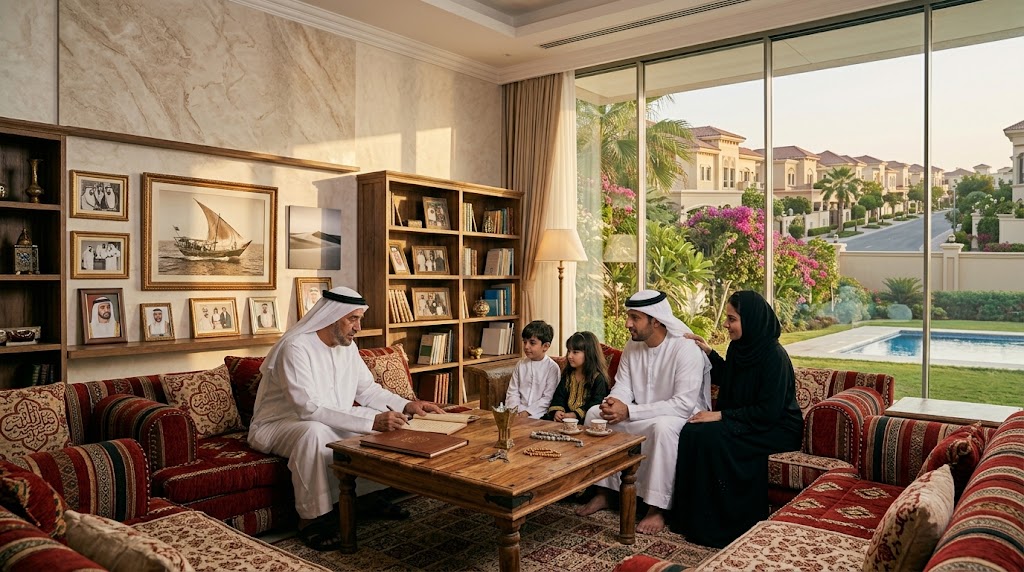
Personal status, family and inheritance cases in the UAE usually begin with a question few people ask: which law governs my family? A citizen, a Muslim expatriate and a non-Muslim are not governed by one rule in marriage, divorce, custody and inheritance, and a registered will, or the lack of one, can change the whole outcome. The direct answer: most family disputes follow a clear route. It starts with the family guidance committee and an attempt at reconciliation, then a claim before the personal status court if reconciliation fails, then enforcement of the judgment on maintenance, custody or the estate.
In this guide to personal status law in the UAE we map the whole route for husbands, wives and heirs alike: from the applicable law, family guidance and the marriage contract, to divorce, khulʿ and judicial divorce and the wife’s rights afterwards, then maintenance, custody, visitation, travelling with the child and establishing parentage, through to inheritance, wills and enforcement. Each stage is summarised here, with a detailed article at the end of each section.
If you are looking for a family lawyer in Dubai for a live matter, all the articles of AWADH ALMHEIRI LAW FIRM AND LEGAL CONSULTATIONS on this subject are gathered on the Personal Status, Family & Inheritance page.

Which law governs your family matters in the UAE?
The new federal Personal Status Law applies to citizens, and also to non-citizens unless one of them invokes the law of their own country within the limits the law allows. Non-Muslims are governed by a separate federal law on civil personal status, which regulates their marriage, divorce, child custody and inheritance under independent rules.
So the first thing established in any family file is the nationality and religion of both parties and where the marriage was registered, because the answer on rights, time limits and procedure depends on the applicable law.
Read the details in:
Family guidance: the first step before any claim
As a rule, personal status claims are not filed directly in court. They begin with a request to the family guidance committee, which tries to reconcile the parties or reach a settlement on maintenance, custody and housing. Urgent claims and requests provided for by law are the exception.
A settlement recorded before family guidance may have the force of an enforceable instrument, so drafting it precisely matters as much as the judgment itself. Many files are resolved at this stage when they are prepared properly.
Read the details in:
Divorce, Khula, and Judicial Separation in Personal Status Law
The marriage contract, its registration and conditions
A marriage contract in the UAE is registered with the competent authority, and records the dowry and any conditions the spouses agree on, provided they do not contravene the law. Spouses may agree conditions on work, housing or other matters, and a breach of a condition has consequences.
Registering or attesting a marriage concluded abroad is a prerequisite for proving rights before the courts, and an unregistered marriage opens disputes on parentage, maintenance and inheritance that could have been avoided.
Read the details in:
Divorce, khulʿ and judicial divorce for harm
A marriage ends by the husband’s divorce, by khulʿ where the parties agree on consideration, or by judicial divorce granted by the court at the wife’s request on grounds set by law, such as harm, absence or failure to provide maintenance. Each route has its own conditions and financial consequences.
In divorce for harm in particular, the facts and evidence are decisive: the court assesses the harm and appoints arbitrators where necessary. It is wise to document events as they happen, before reaching court.
Read the details in:
Divorce, Khula, and Judicial Separation in Personal Status Law
Divorce of foreigners and non-Muslims in the UAE
A Muslim foreigner is in principle subject to the federal Personal Status Law unless they invoke the law of their own country, while non-Muslims are subject to the civil personal status law, which allows divorce at the request of either spouse without proving harm, with separate rules on financial rights and joint custody.
Recognition of the divorce in the parties’ home country matters just as much, as some countries require specific procedures or attestations. The right route should therefore be chosen before filing, not afterwards.
Read the details in:
The wife’s rights after divorce
After divorce the wife has financial rights, most notably the deferred dowry, maintenance during the waiting period, and compensation (mutʿa) in the cases the law provides, together with custody fees and housing if she is the custodian, and her right to her own household belongings.
These rights differ according to the type and cause of the separation; khulʿ, for example, has different effects from divorce or judicial divorce for harm. So do not give up a right before you know what you receive in return.
Read the details in:
Maintenance and how to claim it
Maintenance is a right of the wife, the children and certain relatives, and covers food, clothing, housing, medical care, education and whatever custom requires. The court assesses it according to the means of the person liable and the needs of the person entitled.
Temporary maintenance may be requested until the claim is decided, and maintenance may be increased or reduced if circumstances change. Salary and income statements are the basis on which the claim and the assessment are built.
Read the details in:
Custody: who holds it and when does it end?
Custody is first a right of the child before it is a right of the parents, and its standard is the child’s best interest. The new law has reorganised the age at which custody ends, and gives the child, on reaching a certain age, the right to choose which parent to live with, unless their interest requires otherwise.
Custody lapses or transfers if the custodian no longer meets its conditions, and the guardian keeps the right to oversee the child’s affairs and education. A custody dispute is decided on evidence of the child’s interest, not on allegations.
Read the details in:
Visitation, overnight stays and travelling with the child
The non-custodial parent has the right to see the child, have them stay and take them out as ordered by the court or agreed by the parties, and may keep in touch through modern means. Setting out visitation in clear detail prevents many later disputes.
Travelling with the child outside the country is restricted and, as a rule, requires the other parent’s consent or the court’s permission. A travel ban on the child may be requested if there is a risk of removal without permission.
Read the details in:
Establishing parentage
Parentage is established by the marriage bed, by acknowledgment and by evidence, and the court may rely on scientific means such as DNA testing in the cases the law allows. Established parentage gives the child the right to maintenance, inheritance, identity and official documents.
Claims to establish or deny parentage have precise procedures and time limits, and delay can weaken the legal position, especially where the marriage was not registered.
Read the details in:
Islamic inheritance and distribution of the estate
The estate of a deceased Muslim is distributed according to the rules of Islamic Sharia codified in the Personal Status Law, after his debts are paid and his will is carried out within one third. The process starts with obtaining the certificate of inheritance and inventorying the estate.
Estate disputes often concern the inventory of assets, an heir disposing of estate property before division, or managing the family company after its founder’s death. An estate liquidator may be requested, or a judicial division where agreement is not possible.
Read the details in:
Wills of non-Muslims and estates without a will
Non-Muslims may register their wills in the UAE under the rules that govern this, and a registered will determines who inherits and who becomes guardian of minor children. Without a will, the legal rules of inheritance apply, and their distribution may differ from what the deceased expected.
When an expatriate dies without a registered will, their accounts and assets are frozen until the court orders their distribution, which can take time and weigh heavily on the family. Registering a will early is the most important protection.
Read the details in:
Why Registration of Wills in Dubai for Non-Muslims is Essential
What Happens to the Assets of a Deceased Expat Without a Will in UAE?
Enforcing maintenance and custody judgments and travel bans
A maintenance or custody judgment is enforced through an enforcement file, in which the salary or accounts may be attached, and a travel ban may be requested against a judgment debtor who refuses to pay. Visitation and handover of the child are enforced through special procedures that respect the child’s interest.
Conversely, the judgment debtor may ask for a travel ban to be lifted by paying what is due or providing sufficient security, or if the circumstances on which the judgment was based have changed.
Read the details in:
Personal status cases before the competent authorities in Dubai
In Dubai the Personal Status Court within the Dubai Courts hears marriage, divorce, maintenance, custody and estate claims, preceded as a rule by the family guidance section. Non-Muslims have special procedures for civil divorce and registration of wills.
That is why spouses and heirs look for a family lawyer in Dubai who knows the law applicable to each case, manages the amicable stage as well as the claim, and follows the judgment through to enforcement.
Read the details in:
The Best Personal Status Lawyer: Divorce, Alimony, Custody... Selection Criteria
Law Firm in Dubai: Comprehensive Legal Services for Individuals and Companies
What should you prepare before starting your family case?
Documents
Keep the marriage contract, the children’s birth certificates, passports and IDs, and any previous agreement between the parties.
Financial position
Gather evidence of the income of the person liable for maintenance and the family’s actual expenses for housing, education and medical care.
Family guidance
Start with a request to family guidance, state your claims clearly, and do not sign a settlement before reviewing it.
Estate and will
If the dispute concerns an estate, gather the certificate of inheritance and a statement of assets, and check whether a registered will exists.
How do you check a lawyer’s licence before appointing them?
Make sure whoever represents you is an enrolled, licensed advocate. In Dubai you can search by the lawyer’s or firm’s name in the roll of advocates at the Legal Affairs Department of the Government of Dubai, and at federal level in the Ministry of Justice records. Service and typing offices have no right of audience before the courts, as Federal Decree-Law No. (34) of 2022 reserves that to enrolled advocates.
Legal references
1- Federal Decree-Law No. (41) of 2024 Promulgating the Personal Status Law.
2- Federal Decree-Law No. (41) of 2022 on Civil Personal Status.
3- Federal Decree-Law No. (42) of 2022 Promulgating the Civil Procedure Law.
4- Federal Decree-Law No. (34) of 2022 Regulating the Advocacy and Legal Consultancy Profession.

Frequently asked questions about personal status, family and inheritance in the UAE
Dubai
AWADH ALMHEIRI LAW FIRM AND LEGAL CONSULTATIONS in Dubai provides its services in personal status, family and inheritance matters to citizens and residents of all faiths: representation before family guidance and the Personal Status Court of the Dubai Courts, divorce, khulʿ and divorce-for-harm claims, maintenance, custody, visitation and travel with the child, establishing parentage, civil divorce for non-Muslims, certificates of inheritance and division of estates, registration of wills, and enforcement of maintenance and custody judgments. Family lawyer in Dubai, divorce lawyer in Dubai, custody and maintenance lawyer in Dubai.
Other emirates
The firm’s work in personal status matters extends to Abu Dhabi, Sharjah, Ajman, Umm Al Quwain, Ras Al Khaimah and Fujairah, where it represents spouses and heirs, citizens and residents alike, before the family guidance committees and personal status courts, and follows the division of estates and the enforcement of maintenance and custody judgments.