
 العربية
 Русский
 اردو
اردو
 中文
中文
 Français

Real Estate
Real Estate Guarantee Account in Dubai: Is Your Money Protected?
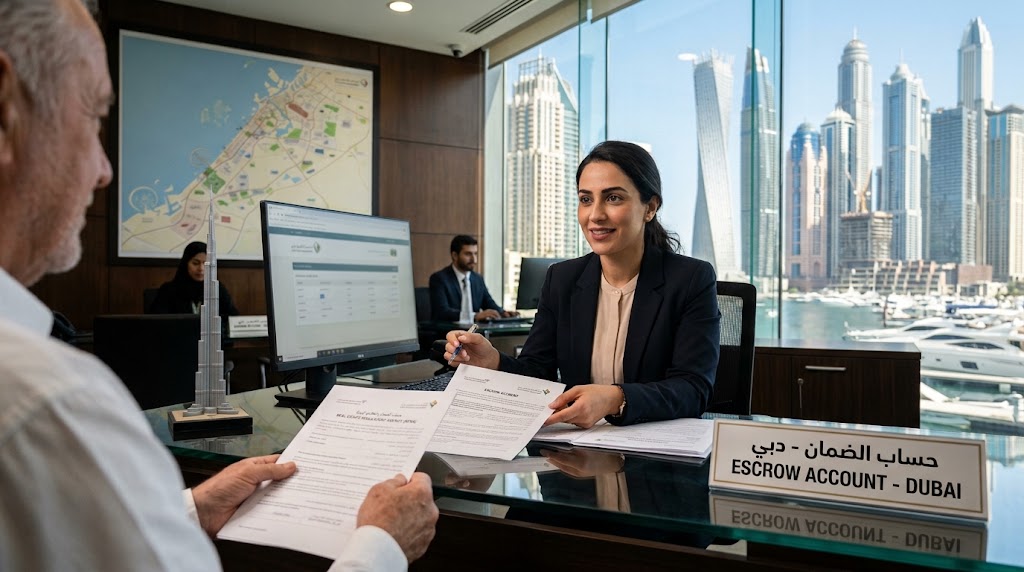
A real estate escrow account in Dubai protects your money only if your money actually goes into it. The law requires every developer selling off-plan to open a separate account for each project with a bank approved by the Dubai Land Department, into which buyers' payments are deposited and from which they are released only for building that project, and the developer's creditors cannot attach them. In practice, however, this protection falls away if you pay by a cheque made out to the company, in cash or to the broker, if you buy in an unregistered project, or if you let the dispute drift after the project is cancelled.
Most escrow cases that reach lawyers do not come from buyers who never heard of the account, but from buyers who trusted it too much: a buyer assumes every amount he paid is protected, then discovers when the project stalls that part of it never entered the account, or that his refund claim is heard by a special committee whose judgments cannot be appealed.
In this article the team at AWADH ALMHEIRI LAW FIRM AND LEGAL CONSULTATIONS explains what the escrow account protects and what it does not, how to check it before paying, when funds are released to the developer, what happens to your money if the project stops or is cancelled or if you yourself fall behind on payments, and the firm's role at each stage. You will find all articles in this field on the Real Estate category page.

What Is a Real Estate Escrow Account in Dubai?
The escrow account is the bank account of the real estate project into which payments from buyers of off-plan units and from the project's financiers are deposited. It is governed by Dubai Law No. 8 of 2007 concerning Real Estate Development Escrow Accounts, which applies to every developer that sells off-plan units and receives payments for them.
In the Project's Name, Not the Developer's
The account is created by a written agreement between the developer and the escrow agent, a bank or financial institution approved by the Department; it is opened in the project's name and a copy of the agreement is filed with the Department.
A Separate Account for Each Project
Where a developer runs several projects, a separate account must be opened for each one, so the money for your project is not mixed with another, struggling project.
Department Oversight
The escrow agent must provide the Department with periodic statements of the account's receipts and payments, and the Department may request any data and appoint someone to audit it.
Is Your Money Really Protected? What the Escrow Account Covers and What It Does Not
Under Article (9) of Dubai Law No. 8 of 2007, the account is dedicated exclusively to building the project, and the amounts deposited in it cannot be attached in favour of the developer's creditors. If the developer runs up debts or lawsuits, buyers' money in the account stays out of his creditors' reach.
But the account does not protect what never entered it. It does not cover amounts paid outside it, it does not compensate you for late handover, and it does not cure a void contract. Under Dubai Law No. 13 of 2008 regulating the Interim Real Property Register, the sale of an off-plan unit is void if it is not registered in the interim register, and any contract to sell units in a project that has not obtained the competent authorities' approval is void.
How to Check the Escrow Account Before You Pay
Checking before paying is far cheaper than litigating afterwards. The key points: the developer must be entered in the Department's register of real estate developers, the project must hold the approvals and the permit to advertise and sell off-plan, the escrow account number and project name must appear in the sale contract, and your contract must be registered in the interim real property register.
A buyer has a legal right to view his own accounting records held by the escrow agent and to request copies. Reading these records and matching them against the contract, the payment schedule and the completion rate, however, requires experience, which is why the firm reviews the project file and the contract for investors before signing and identifies the risks before a single dirham is paid.
Paying Outside the Escrow Account: The Most Dangerous Mistake a Buyer Makes
A cheque made out to the developer company, a transfer to its general business account, a cash payment, or money handed to the broker to "pass on" to the developer: all of these are funds outside the account. They are not protected from attachment, their release is not tied to the completion rate, and they are hard to trace if the developer defaults.
The law makes it a crime to embezzle, misuse or dissipate payments handed over for building real estate projects, punishable by imprisonment and a fine of not less than AED 100,000, or either penalty, as it does knowingly offering units in fictitious projects and a developer dealing with a broker not registered with the Department. Yet a criminal penalty does not automatically return your money; it requires a parallel civil claim that must be properly coordinated with the criminal complaint.
When Is Money Released from the Escrow Account to the Developer?
As a rule, escrow funds are released only for building the project, in line with construction progress and the procedures approved by the Department. If the developer mortgages the project to obtain a loan, the lender must deposit the loan amount into the same escrow account.
Once the developer obtains the completion certificate, the escrow agent retains 5% of the total value of the account, which is released to the developer only one year after the units are registered in the buyers' names. This retention is an important card for a buyer who discovers defects after handover, provided he acts in time.
If the Project Stops or Is Cancelled: How Do You Recover Your Money from the Escrow Account?
If emergency circumstances prevent completion of the project, the escrow agent, after consulting the Department, must take the measures needed to protect depositors' rights, either by completing the project or by returning their money. If the Real Estate Regulatory Agency cancels the project by a reasoned decision, the developer must return all amounts paid in accordance with the Escrow Accounts Law.
The dispute itself is not filed before the ordinary courts. Under Dubai Decree No. 21 of 2013, a special judicial committee was formed to liquidate cancelled real estate projects. It has exclusive jurisdiction over claims and applications between developers and buyers relating to these projects, and all Dubai courts, including the DIFC Courts, are barred from hearing them. The committee may appoint auditors at the developer's expense to trace what was paid to the developer and what was deposited in the account, and may order the escrow agent or the developer to return the money to its owners.
The real risk here is that the committee's judgments are final and cannot be challenged through ordinary means of appeal. Your file is decided the first time, with no room to add a document that was not filed or an amount that was not proven. That is why the firm prepares the buyer's file in full: the contract, the receipt for every payment, what entered the account and what was paid outside it, and the correspondence, then follows the case before the committee through to enforcement.
If You Fall Behind on Payments: What Is the Developer Entitled To?
Under Article (11) of Dubai Law No. 13 of 2008, as amended by Law No. 19 of 2017, the developer cannot terminate your contract directly. He must notify the Dubai Land Department, which verifies the breach, gives you 30 days to perform, and attempts a settlement. If you do not perform, it issues the developer a document stating the unit's completion rate, and his rights depend on that rate:
Completion Above 80%
The developer may keep the contract and claim the balance, request that the unit be sold at auction to recover it, or terminate the contract and retain up to 40% of the unit's value.
Completion Between 60% and 80%
The developer may terminate the contract and retain up to 40% of the unit's value.
Completion Below 60% with Construction Started
The developer may terminate the contract and retain up to 25% of the unit's value.
Construction Not Started for Reasons Beyond the Developer's Control
The developer may terminate the contract and retain up to 30% of the amounts paid.
These rules are a matter of public order, and the buyer keeps the right to go to court or arbitration if the developer abuses them. Many of these files are won by challenging the approved completion rate or the validity of the notice, or by proving that the developer himself was in breach before the buyer, questions that can only be settled by a careful study of the contract and documents.
Escrow Accounts in Abu Dhabi
In Abu Dhabi, real estate project escrow accounts are supervised by the Abu Dhabi Real Estate Centre, which offers services to register escrow account agreements and to enquire about the amounts deposited. The principle is the same: pay only into the project account and check before signing, though the authorities and procedures differ, which the firm takes into account when representing buyers in Abu Dhabi.
The Firm's Role in Escrow Account Disputes
Before Buying
Reviewing the sale contract, the project file, the developer's registration and the escrow account details, and identifying the clauses that shift risk onto you.
On Delay or Breach
Sending notices, claiming against the developer, filing complaints with the competent authorities, and avoiding a termination in which the developer keeps part of your money.
On Cancellation or Stalling
Preparing the full claim file before the special judicial committee or the competent court, and tracing the money inside and outside the account through to enforcement.
Read more: Real Estate and Contracting Issues in the UAE; Real Estate Disputes in the UAE: Key Challenges and Solutions
Deadlines and Percentages You Should Know
30 daysThe period the Department gives a defaulting buyer to perform before the developer may take termination measures.
5% for 1 yearRetained by the escrow agent after the completion certificate and released only one year after the units are registered in the buyers' names.
6 monthsIf the developer does not start construction within this period from the off-plan sale approval without acceptable excuse, his registration is struck off.
60 daysDeadline to refund the excess to the buyer after resale of the unit whose contract was terminated, or one year from termination, whichever comes first.
Tips Before You Pay Any Amount
Pay instalments only into the escrow account stated in the project's name in your contract, and never accept a cheque or transfer in the name of the company or the broker.
Keep the receipt for every payment and a statement proving it entered the account; these documents are your file if the project is cancelled.
Make sure your contract is registered in the interim real property register, as an unregistered sale may be void.
Do not stop paying or send a termination notice when the developer is late before reviewing the contract and the completion rate with a specialised lawyer.
If the project is declared cancelled, do not file a case before the ordinary court: jurisdiction lies with the special committee, whose judgments cannot be challenged by ordinary appeal.
Legal References
Dubai Law No. 8 of 2007 concerning Real Estate Development Escrow Accounts in the Emirate of Dubai
Dubai Law No. 13 of 2008 regulating the Interim Real Property Register in the Emirate of Dubai and its amendments, including Law No. 19 of 2017
Dubai Decree No. 21 of 2013 forming a Special Judicial Committee for the Liquidation of Cancelled Real Estate Projects in the Emirate of Dubai and the Settlement of Related Rights
Executive Council Resolution No. 6 of 2010 approving the Implementing Regulation of Law No. 13 of 2008
Dubai Law No. 7 of 2006 concerning Real Property Registration in the Emirate of Dubai
Dubai Law No. 16 of 2007 establishing the Real Estate Regulatory Agency
Frequently Asked Questions About Real Estate Escrow Accounts in Dubai

Dubai
AWADH ALMHEIRI LAW FIRM AND LEGAL CONSULTATIONS in Dubai handles real estate escrow account and off-plan cases: reviewing contracts before purchase, claiming against developers for delay, and recovering money when projects are cancelled before the special judicial committee and the Dubai Courts. Escrow account lawyer in Dubai and off-plan property lawyer.
Other Emirates
The firm serves buyers and investors in Abu Dhabi, Sharjah, Ajman, Umm Al Quwain, Ras Al Khaimah and Fujairah in off-plan disputes and real estate project escrow accounts, before the real estate authorities and the competent courts.