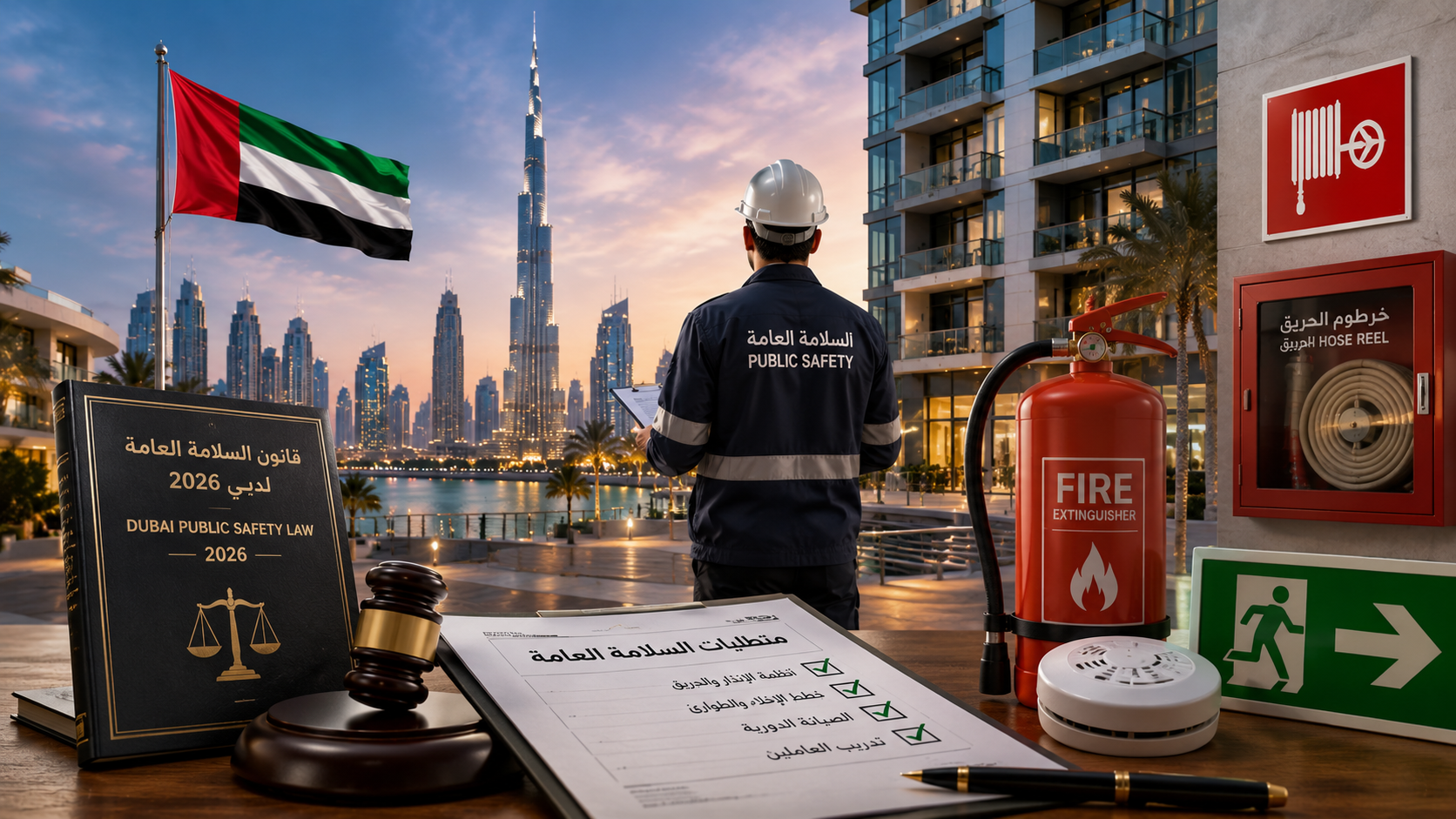
What Every Owner and Business Should Know About Dubai's Public Safety Law
On 27 February 2026, His Highness Sheikh Mohammed bin Rashid Al Maktoum, Vice President and Prime Minister of the UAE and Ruler of Dubai, enacted Dubai Law No. 2 of 2026 on Public Safety in the Emirate of Dubai. The Law enters into force on 1 June 2026, establishing a comprehensive legislative framework to protect lives and property and ensure the highest standards of safety across all public places, entertainment venues, event sites, and buildings in the Emirate.
What Every Property Owner, Operator, and Business Must Know About Dubai's New Public Safety Law
I. Scope of Application
The Law applies across a broad geographical and sectoral scope, covering all public places, entertainment venues, event sites, and buildings in the Emirate of Dubai, including:
Special Development Zones within the Emirate
Free zones, including the Dubai International Financial Centre (DIFC)
Public parks, squares, sports venues, commercial markets, restaurants, hotels, shopping destinations, beaches, and shared swimming pools
Cinemas, theatres, opera houses, amusement parks, concert venues, and sports and gaming halls
Occupied buildings, including private residential villas
⚠ Exemptions from the Law's Scope
The Law does not apply to airports and their buildings and infrastructure, military and security facilities, waterways, seaports, and dry docks, land, sea, and air transport vehicles, industrial, professional, and craft establishments and buildings, or buildings still under construction — except for parts open to the public.
II. The Authority Responsible for Implementation
The Environment, Health and Safety Institution (the "Institution"), affiliated with Dubai Municipality, is responsible — in coordination with the relevant authorities — for overseeing and monitoring public safety across the Emirate. Its powers include:
Setting Conditions and Controls
Establishing the conditions required to prevent accidents and mitigate risks in all places subject to the Law.
Issuing Permits
Issuing permits for entertainment venues and public event sites after verifying compliance with public safety requirements.
Oversight and Inspection
Conducting monitoring and inspection operations, including through the use of drones and smart applications.
Accident Investigation
Investigating the causes of accidents, establishing preventive measures, and developing appropriate solutions to prevent recurrence.
Accrediting Safety Supervisors
Accrediting public safety supervisors and determining the qualification and training requirements applicable to each type of premises.
Awareness Campaigns
Organising public safety awareness campaigns and issuing guidelines and instructions relating to public safety requirements.
III. Public Safety Requirements by Type of Premises
Article 6 — Public Places, Entertainment Venues, and Event Sites
Core Requirements in Publicly Accessible Premises
Equipment designs must conform to approved standards; adequate lighting and ventilation must be provided; safe entry and exit for the public must be organised; the permitted occupancy capacity must be observed; fire suppression equipment and fire-fighting systems must be provided; first aid requirements must be available; alarm systems and warning signs must be installed; emergency and rescue services must be accessible; and dedicated facilities for the elderly, persons with disabilities, and children must be provided.
Article 8 — Occupied Buildings
Safety Requirements in Residential and Commercial Buildings
Electric lifts or escalators must be provided in accordance with approved specifications; protective barriers against falls (handrails) must be fitted on all staircases, rooftops, and balconies; a public safety supervisor must be appointed in buildings meeting the criteria determined by the Director General; and fire-fighting equipment, evacuation systems, and first aid requirements must be provided.
Article 9 — Residential Homes
Safety Requirements in Private Homes
Fire detection devices must be installed and connected to the electronic protection network for homes; measures must be taken to protect against falls and hazards from electrical installations, solar energy systems, and smart technology; swimming pool safety measures must be provided; noise level limits set by law must be observed; and measures for the safe use of domestic cooking gas must be in place.
Article 11 — Permanent Swimming Pools
Requirements for the Construction and Operation of Swimming Pools
No swimming pool may be constructed in the Emirate without first obtaining the Institution's approval of the pool plans and design. This requirement applies expressly to swimming pools in private residential villas. Shared permanent pools must also obtain a completion certificate, appoint a qualified lifeguard, and install a barrier separating the adults' pool from the children's pool.
Article 13 — Beaches
Public Safety Requirements on Beaches
All necessary permits and approvals must be obtained from Dubai Municipality and the relevant authorities for activities and events held on beaches, including water sports. Beaches must be equipped with all required rescue and safety equipment, including watchtowers and lifeguards. Designated swimming hours must be established and separate areas for water sports must be demarcated using water buoys.
IV. Obligations of Owners, Operators, and Service Providers
Article 14 of the Law imposes a range of substantive obligations on owners, the most significant of which are:
01
Obtain a Permit Before Operating an Entertainment Venue
Public safety requirements must be met and a permit obtained from the Institution prior to opening, and whenever any change or modification is made that may affect public safety.
02
Prepare a Comprehensive Emergency Plan
The emergency plan must include measures to prevent overcrowding, evacuate the public, reach safe areas, and provide first aid — all in accordance with the Institution's requirements.
03
Conduct Periodic Technical Inspections of Equipment
Inspections must be carried out by companies accredited by Dubai Municipality, and inspection certificates must be kept on the premises and made available to authorised officials upon request.
04
Appoint and Train Public Safety Supervisors
In accordance with the Institution's accreditation requirements, with periodic training on the equipment and devices used at the relevant premises or site.
05
Report Accidents and Injuries to the Institution
Within the timeframes and in the cases specified in the guidelines approved by Dubai Municipality, and to submit a risk assessment report detailing the measures taken.
06
Prepare a Detailed Risk Assessment Study
The study must include the procedures to be followed in the event of any accident. Specialist accredited companies may be engaged to assist in preparing the study.
V. Prohibited Acts Under the Law
Article 16 of the Law sets out a number of prohibited acts that give rise to legal liability:
Trading in or using explosives, fireworks, toxic products, hazardous gases, or flammable liquids without a permit from the competent authorities
Storing waste in a manner that constitutes a public safety hazard, particularly in areas readily accessible to the public
Trading in tools, devices, or products that fail to meet public safety requirements, pose a hazard to the public, or do not bear user instructions in both Arabic and English
Tampering with inspection chambers, sanitary drainage outlets, or stormwater drainage outlets
Engaging in activities that pose a public safety hazard without a permit from the Institution and the relevant authorities
VI. Fines and Administrative Sanctions
Violation
Sanction
Violation of any provision of the Law or decisions and guidelines issued thereunder
Fine of no less than AED 500 and no more than AED 1,000,000
Repeat violation within one year of the preceding violation
Fine doubled, not exceeding AED 2,000,000
Products that pose a public safety hazard
Seizure, destruction, or re-export at the violator's expense
Premises posing a public safety hazard
Partial or full closure until the cause of the violation is remedied
Failure to remedy the violation within the specified period
Remediation carried out at the violator's expense, plus a 25% administrative surcharge
ℹ Right to Grievance
Any interested party may file a written grievance against decisions, procedures, or measures taken against them within ten working days of being notified thereof. The grievance shall be decided upon within thirty days of submission by a committee formed for this purpose, and the committee's decision shall be final.
VII. Obligations of the Public
The Law does not restrict its obligations to owners and operators alone — members of the public are equally required to comply with the following:
Comply with Safety Instructions
Adhere to all public safety procedures, instructions, and guidelines applicable in the premises and venues visited.
Follow Equipment Guidelines
Observe the instructional guides relating to the use of devices, machinery, and equipment available in those premises and venues.
Cooperate During Incidents
Cooperate fully with public safety supervisors, owners, and the relevant authorities during accidents or emergency situations requiring evacuation.
Supervise Children
Supervise Children
Act with care and monitor children's behaviour in public places, entertainment venues, and event sites.
Observe Swimming Hours
Comply with the permitted swimming hours at public beaches and refrain from exceeding designated boundaries.
Do Not Enter Restricted Areas
Refrain from entering areas designated for employees or any area to which public access is not permitted.
VIII. Compliance Period
The Law grants those subject to its provisions a transitional period to bring their affairs into compliance with its requirements:
The Law enters into force on 1 June 2026
A compliance period of two years is granted from the date of entry into force
This period may be extended for a further equivalent period by a decision of the Chairman of the Executive Council, based on a recommendation from the Director General, in circumstances that so require
IX. Frequently Asked Questions
Does the Law apply to free zones and the DIFC?
Yes. Article 3 of the Law expressly states that its provisions apply to all premises in the Emirate of Dubai, including Special Development Zones and free zones — including the Dubai International Financial Centre — without exception.
Does the owner of a private villa with a swimming pool need the Institution's approval?
Yes. Under Article 11 of the Law, no swimming pool may be constructed in the Emirate without first obtaining the Institution's approval of the plans and design. This requirement applies expressly to swimming pools in private residential villas.
What is the penalty for a repeated violation?
The value of the fine is doubled if the violation is repeated within one year of the date of the preceding violation, subject to a maximum of AED 2,000,000, as provided under Article 19 of the Law.
Who bears liability for damages suffered by the public as a result of safety violations?
Under Article 25 of the Law, Dubai Municipality and the relevant authorities bear no liability towards third parties for any damages arising from an owner's failure to comply with public safety requirements. The owner alone shall be liable for such damages.
Is it mandatory to appoint a public safety supervisor in a residential building?
Article 8 requires the appointment of a public safety supervisor in buildings that meet the criteria to be determined by a decision of the Director General. This means the obligation may apply to certain types of residential and commercial buildings, and owners should verify the applicable requirements once the relevant decision is issued.
How long is the compliance period?
The Law grants a two-year compliance period from its entry into force on 1 June 2026 — that is, until 1 June 2028. This period may be extended by a decision of the Chairman of the Executive Council, based on a recommendation from the Director General, in circumstances that so require.
Are inspection officers permitted to use drones?
Yes. Article 18 of the Law authorises Dubai Municipality's competent employees to use devices, equipment, and smart applications — including drones — to conduct monitoring and inspection operations in accordance with the legislation in force in the Emirate.
X. Practical Guidance for Compliance
Review Your Legal Position Now
Verify that your establishment or building complies with all safety requirements set out in the Law before the two-year compliance period expires.
Obtain Permits Before Opening
The Law requires a safety permit to be obtained before operating any entertainment venue or making any substantive modification to an existing one.
Document Risk Assessment Studies
Prepare a detailed risk assessment study and emergency plan. Accredited specialist companies may be engaged to assist where required.
Appoint a Qualified Safety Supervisor
Verify the Institution's requirements regarding the qualification and training of safety supervisors specific to your type of premises.
Do Not Build a Pool Without Approval
Whether in a commercial project or a private villa, ensure the Institution's approval of the plans is obtained before commencing construction.
Maintain Maintenance and Inspection Records
Keep periodic inspection certificates for all equipment on the premises and ensure they are available for review by authorised officials upon request.
Specialised Legal Consultation
Do you need assistance complying with the new Public Safety Law?
Dubai Law No. 2 of 2026 on Public Safety imposes new obligations on owners, operators, and facility managers alike. The team at Awad Al Mehiri Law Office is ready to guide you towards full compliance and help you avoid penalties.
✓
Reviewing your establishment's position in light of the Law's new requirements
✓
Assisting with the procedures for obtaining the necessary permits
✓
Legal representation in cases involving violations, fines, and grievances
✓
Providing legal advice on risk assessment studies and emergency plans
Contact Awad Al Mehiri Law Office for expert legal counsel and to take the necessary steps to safeguard your rights.
Disclaimer
The information contained in this article is of a general legal and informational nature, and is based on Dubai Law No. 2 of 2026 on Public Safety in the Emirate of Dubai, issued on 27 February 2026. It does not constitute specialised legal advice and should not be relied upon as the sole basis for any legal decision. Legal situations vary according to their specific circumstances and facts. Readers are advised to consult a qualified legal specialist to obtain advice tailored to their individual situation.

 العربية
 Русский
 اردو
اردو
 中文
中文
 Français