 العربية
 Русский
 اردو
اردو
 中文
中文
 Français

Civil Litigation
Civil Cases in the UAE

Civil cases in the UAE are any dispute between individuals, or between individuals and companies, over a financial right or compensation outside the scope of trade and crime: a loan not repaid, a contract not performed, harm caused to you by someone else’s act, or money paid without a valid reason. They are the door most people knock on when they say “I want to file a case”, and the first question is always the same: what can I prove, and what is the shortest route to recovering my right?
Many people confuse the civil and criminal routes, going to the police over a dispute that is essentially financial, or giving up their right to compensation after a criminal judgment in their favour. The practical rule is that a crime punishes the offender, while money and compensation belong in the civil claim, and each route has its own evidence and deadlines.
This guide explains civil cases and their stages in practical language, from the claim to the judgment and its enforcement, and for each issue points you to a detailed article in the Civil Cases and Civil Liability section, so you read the overview here and the detail there.

When is a case civil rather than commercial or criminal?
A case is civil when it concerns a financial right or compensation between persons who are not dealing as traders in the course of their business: a loan between friends, the sale of a car between two individuals, damage from a neighbour, or a professional error that harmed a client. It is governed by the Civil Transactions Law and heard by the civil chamber. Where the act is also a crime, the injured party may claim compensation before the civil court or alongside the criminal case, depending on what suits the file.
Read more: Turning a criminal complaint into a civil dispute and Criminal cases in the UAE.
Financial claims and debts between individuals
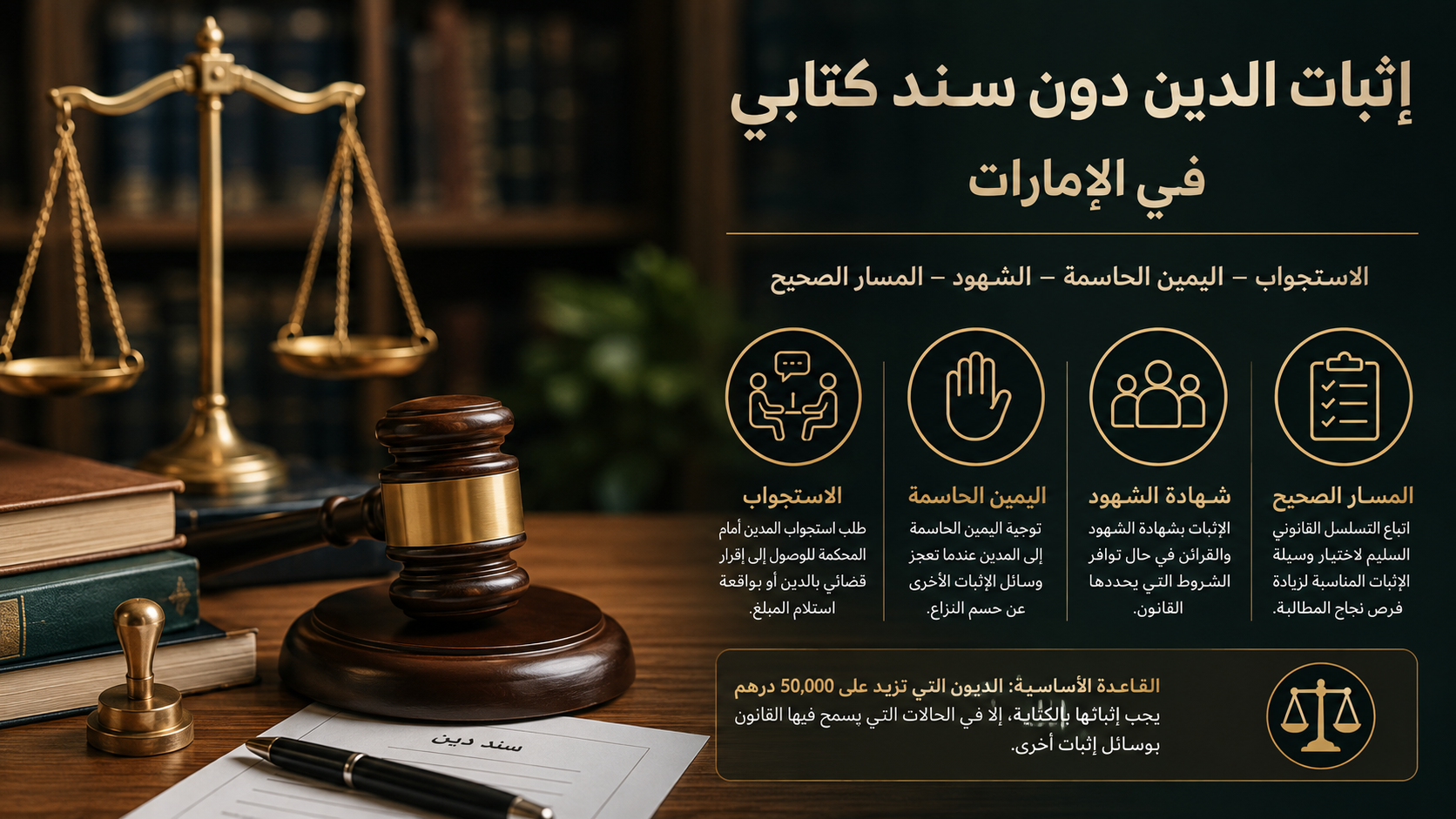
The most common civil case is money lent and not repaid. If the debt is established in writing, fixed in amount and due, a payment order is the fastest route; otherwise a civil claim. Many loans between individuals are made by bank transfer and messages without a contract, and here gathering and organising the evidence before making the claim is what decides the case.
Read more: Proving a debt without written evidence, WhatsApp messages as evidence of a loan, The payment order: conditions and procedure and Debt collection: the client did not pay the invoice.
Breach of contract: performance, termination or compensation
If the other party breaches the contract, the injured party generally has three options: to demand performance, to terminate the contract and recover what he paid, or to claim compensation for the loss, and some of these may be combined. The right choice depends on the wording of the contract, whether performance is still possible and useful, and any prior notice required by law or by the contract.
Read more: Refunding the deposit after withdrawing from a purchase and Contract drafting in the UAE.
Tort liability: compensation for harm
Anyone who causes harm to another must compensate it, even without a contract between them. Compensation rests on three elements: a harmful act, actual damage, and a causal link between them. The damage may be material, such as loss of property or of earnings, or moral, such as harm to reputation or emotional suffering, and both are compensable once proved. A practical example is defamation and abuse on social media, where the injured party may claim compensation alongside or after the criminal case.
Read more: Insult, defamation and disclosure of private information.
Compensation for accidents and insurance companies
In vehicle accidents and injuries, civil compensation overlaps with the obligations of insurance companies. The injured party may claim directly from the insurer within the limits of the policy, turn to the authorities competent for insurance disputes, or go to court if the claim is rejected or the compensation is assessed below the actual loss. Documenting the accident, the medical reports and the repair invoices from day one is the basis of any claim.
Read more: Recovering a garage’s dues from the insurance company.
Liability for the acts of others and for things
Liability is not limited to the person who committed the act. An employer may be liable for harm caused by an employee during or because of his work, and the owner of a building, an animal or a machine may be liable for the harm it causes. These rules matter because they give the injured party a debtor better able to pay than the person who directly caused the harm.
Recovering money paid without a valid reason
Whoever transfers money by mistake to someone else’s account, pays a debt that was not owed, or pays for a service that was never provided may recover it from the person enriched at his expense without a lawful cause. The claim usually starts with a documented notice, then a claim for restitution if the money is not returned, bearing in mind that this claim has a period after which it lapses.
Liability of professionals and managers
A doctor, engineer, accountant, contractor or company manager may each be civilly liable for an error in performing his work that harmed his client or a third party. The test is not the result alone, but whether he exercised the care that someone in his position would exercise in the same circumstances, or achieved the result he undertook. These cases depend heavily on the technical expert appointed by the court.
Time limits for filing a civil claim
A civil right does not last forever. Each type of claim has a limitation period after which it is no longer heard if the opponent relies on it, and the period differs between a debt claim, a tort claim and a restitution claim. Hence the importance of acting early and keeping anything that interrupts limitation, such as a demand or an acknowledgement of the debt.
From judgment to enforcement
A civil judgment in your favour opens two stages: the deadlines for any appeal by the opponent, then enforcement against his assets by attaching his accounts or property, which may extend to a travel ban where its conditions are met. Conversely, the party against whom the judgment was given has means to appeal and to object to enforcement within their deadlines.
Read more: Enforcement of judgments and travel bans in the UAE, Judgments in absentia: opposition, appeal and cassation and Staying enforcement and setting aside the enforceable instrument.
When the opponent is outside the country
If the debtor has left the country or lives abroad, a claim is still possible, but service of process requires special procedures, and the decisive question is where his assets are and whether the judgment will be enforced there. The reverse also applies: a foreign judgment against someone with assets in the UAE can be enforced under specific conditions.
Read more: Filing a lawsuit against a person outside the UAE and Enforcing a foreign judgment in the UAE.
Civil cases before the Dubai courts
The Civil Transactions Law and the Civil Procedure Law are federal and apply across all seven emirates, but the practical procedure varies by emirate. In Dubai, certain civil disputes pass through an amicable settlement stage before registration, the courts have their own electronic platform for registration, service and enforcement, and a question of jurisdiction may arise between the Dubai Courts and the DIFC Courts.
Read more: The judicial authority for resolving conflicts of jurisdiction in Dubai. For the firm’s full services, see Law firm in Dubai.
What to prepare before contacting a civil lawyer
Facts
A chronology
What happened, in order and with dates, who the other party is and your relationship with him, without explanation or justification.
Evidence
Documents and correspondence
The contract if any, bank transfers, receipts, messages, photographs, and medical or technical reports.
Loss
What you actually lost
Amounts paid, repair or treatment costs, lost earnings, and what proves each figure.
Steps
What has been done so far
Any complaint, notice, grievance or previous judgment, with its number and the authority that issued it.
How to verify a lawyer’s licence before appointing him
Before signing any power of attorney, verify that the person you are dealing with is a registered and licensed lawyer with a right of audience before the court competent for your case. The Legal Affairs Department of the Government of Dubai maintains an electronic directory of licensed lawyers, legal consultants and firms that can be used to check a name and a firm. The professions of advocacy and legal consultancy in the UAE are regulated by Federal Decree-Law No. 34 of 2022 and its executive regulations.
If you are outside the country, a power of attorney can be granted without attending in person: How to appoint a lawyer while outside the UAE.
Legal references
Federal Decree-Law No. 25 of 2025 issuing the Civil Transactions Law.
Federal Decree-Law No. 42 of 2022 issuing the Civil Procedure Law.
Federal Decree-Law No. 35 of 2022 issuing the Law of Evidence in Civil and Commercial Transactions.
Federal Decree-Law No. 38 of 2022 issuing the Criminal Procedure Law.
Federal Decree-Law No. 34 of 2022 regulating the professions of advocacy and legal consultancy.

Frequently asked questions on civil cases in the UAE
Our civil litigation services in Dubai and across the UAE
Dubai
AWADH ALMHEIRI LAW FIRM AND LEGAL CONSULTATIONS handles civil cases in Dubai before the courts at every level and the amicable settlement centres: financial claims and debts between individuals, breach and termination of contracts, claims for material and moral damage, recovery of money paid without a valid reason, professional liability, and enforcement of civil judgments, for the claimant or the defendant.
The other emirates
The firm’s work extends to Abu Dhabi, Sharjah, Ajman, Umm Al Quwain, Ras Al Khaimah and Fujairah, handling civil cases and compensation claims before their courts, for individuals and companies.