
 العربية
 Русский
 اردو
اردو
 中文
中文
 Français
Dubai Public Safety Law No. (2) of 2026 Takes Effect
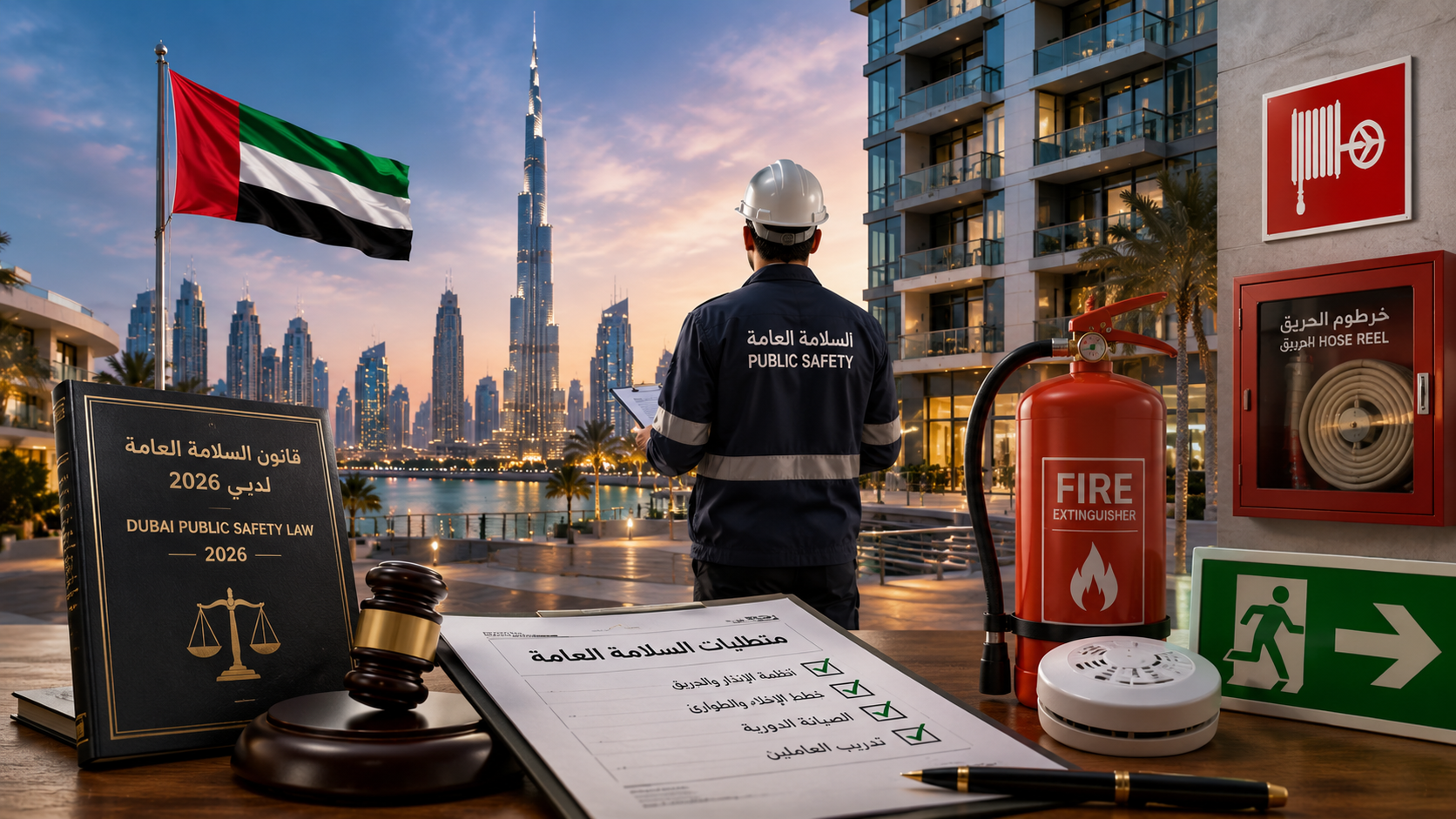
His Highness Sheikh Mohammed bin Rashid Al Maktoum, Vice President of the State, Prime Minister, and Ruler of Dubai, signed the Dubai Public Safety Law No. (2) of 2026 on 27 February 2026. The law enters into force on 1 June 2026, establishing a comprehensive legislative framework aimed at protecting lives and property and ensuring the highest safety standards in all public places, entertainment venues, event sites, and buildings across the emirate.
Dubai Public Safety Law No. (2) of 2026 Enters into Force on 1 June 2026
This law replaces Local Order No. (11) of 2003 concerning public health and community safety, expanding the scope of legislation to cover all aspects of safety across both public and private spaces — in line with the significant transformations witnessed in the Emirate of Dubai in terms of urban growth and tourism and entertainment activity.
The provisions of the law apply comprehensively to public places, entertainment venues, event sites, and buildings in the emirate, extending explicitly to include special development areas and free zones — including the Dubai International Financial Centre (DIFC). Covered premises include public parks, playgrounds, commercial markets, restaurants, hotel establishments, beaches, and shared swimming pools, as well as cinemas, theatres, amusement parks, sports halls, and private residential homes.
Private villa owners are required to obtain approval from the Environment, Health, and Safety Authority before constructing swimming pools
Fire detection devices must be installed in homes and connected to the electronic protection network
Owners of public places and entertainment venues must prepare risk assessment studies and comprehensive emergency plans
Certified public safety supervisors must be appointed in buildings and premises subject to the law
The use of drones and smart applications in monitoring and inspection operations is now authorised
Violators are required to remedy the violation at their own expense, plus a 25% administrative surcharge in cases of municipal intervention
Supervision and oversight of the law's implementation have been entrusted to the Environment, Health, and Safety Authority of Dubai Municipality, in coordination with the relevant authorities. The Authority is responsible for issuing permits for entertainment venues and event sites, verifying compliance with safety requirements, investigating incidents, and maintaining a database of their causes — in addition to supervising and accrediting public safety supervisors. Municipal employees have also been granted the status of judicial officers to establish violations.
Article 19 of the law sets out a graduated system of administrative penalties, with fines starting at no less than five hundred dirhams and not exceeding one million dirhams. In cases of repeated violations within one year of the preceding offence, the fine is doubled, subject to a maximum of two million dirhams. A detailed schedule of violating acts and corresponding fines shall be determined by a decision issued by the Chairman of the Executive Council.
The law guarantees every interested party the right to file a written grievance against decisions, procedures, or measures taken against them, within ten working days of notification. The grievance shall be decided upon within thirty days by a specialised committee, and the committee's decision shall be final.
The law grants those subject to its provisions a two-year period from its entry into force on 1 June 2026 to bring their affairs into compliance — that is, until 1 June 2028. This period may be extended for a similar duration by a decision of the Chairman of the Executive Council in cases that so warrant.