
 العربية
 Русский
 اردو
اردو
 中文
中文
 Français
DIFC & ADGM
Issues of the Dubai International Financial Centre and Abu Dhabi Global Market
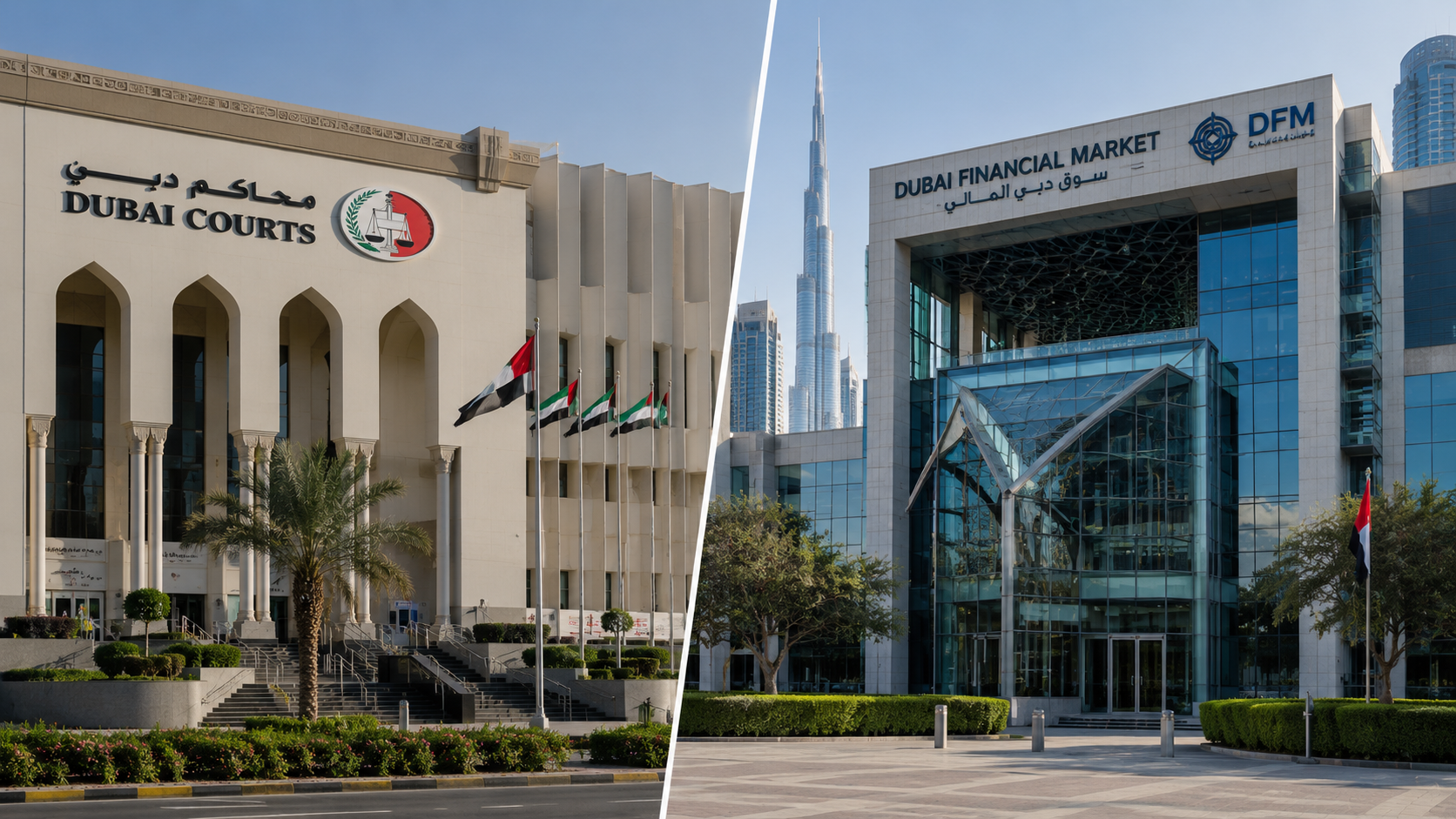
Cases in the Dubai International Financial Centre and Abu Dhabi Global Market do not follow the path most people in the UAE are used to. Both are financial free zones, each with its own civil and commercial laws, its own courts working in English on common law principles, and its own regulator granting financial licences. That is why the first question anyone looking for a DIFC lawyer asks is: does my dispute belong before the DIFC Courts or the Dubai Courts?
The direct answer: the DIFC Courts have jurisdiction where one party is a company registered in the Centre, where the contract was concluded or performed there, or where the parties have agreed in writing to their jurisdiction, even with no connection to the Centre. Crimes, however, remain subject to federal law and the Public Prosecution even when committed inside the Centre. Many people also confuse the Centre with the Dubai Financial Market, which is a stock exchange under entirely different regulation; we explain the difference below.
This guide from AWADH ALMHEIRI LAW FIRM AND LEGAL CONSULTATIONS follows a file as investors and companies actually experience it: formation and licensing, then the contract, then the dispute before the courts or in arbitration, then enforcement. All our specialised articles are collected under the category DIFC and ADGM.

What Is the DIFC, and Why Does It Have Its Own Law and Courts?
The Dubai International Financial Centre (DIFC) is a financial free zone in Dubai with its own civil and commercial legislation: a companies law, an employment law, a data protection law and an insolvency law that are independent of their federal counterparts. The exceptions are criminal law and federal laws that apply throughout the country, such as the anti-money laundering legislation.
Three bodies matter before any step: the Dubai Financial Services Authority (DFSA), which licenses and supervises financial activities; the Registrar of Companies for non-financial entities; and the DIFC Courts for civil and commercial disputes.
Read more in:
Dubai Financial Market or Dubai International Financial Centre?
Many people search for a lawyer for the Dubai Financial Market when they mean one of two quite different things. The Dubai Financial Market (DFM) is an exchange for trading shares and bonds, subject to federal securities regulation, and an investor's disputes with brokers or listed companies go before the federal regulator and then the UAE courts. The DIFC is a financial zone with its own laws and courts, and the confusion grows because Nasdaq Dubai, an exchange operating inside the Centre, is supervised by the DFSA.
Identifying the right body from the outset determines the court, the law and the competent lawyer; getting it wrong can end, months later, in a ruling of no jurisdiction.
Setting Up a Company in the DIFC and Obtaining a Licence
Most investors' files start before any dispute: choosing the legal form of the entity and deciding whether the activity is financial and needs a DFSA licence, or non-financial and only needs registration. The two routes differ widely in requirements and ongoing obligations.
The lawyer reviews the articles of association, the shareholders' agreement, beneficial ownership disclosure and compliance requirements. One costly mistake is carrying on a financial activity before the licence is issued or beyond its scope, which exposes the company and its directors to action by the regulator.
Read more in:
The Jurisdiction Clause: The Decision Made Before Signing
The most important line in any contract touching the Centre is the dispute resolution clause. Since the amendment of the DIFC Courts law, any two parties, even with no link to the Centre, may agree in writing to the jurisdiction of its courts, choose DIFC law to govern the contract, or choose arbitration instead of the courts. A missing or vague clause is what later opens the door to a conflict of jurisdiction.
Each option has its cost in language, procedure and expense, which is why we review the other party and the location of its assets with the client before proposing the wording.
Read more in:
When Do the DIFC Courts Have Jurisdiction, and Who Resolves Conflicts?
The DIFC Courts hear civil and commercial claims in which one party is the Centre, one of its bodies or a company registered in it, claims arising from a contract concluded or performed wholly or partly in the Centre or from an event that took place there, and matters the parties agree in writing to refer to them. They do not hear criminal cases.
If the same claim is filed before both the DIFC Courts and the Dubai Courts, or the two issue conflicting judgments, the matter goes to the Judicial Authority for Resolving Conflicts of Jurisdiction, whose decisions are final and binding and determine the competent court or the judgment to be enforced.
How Does a Case Proceed Before the DIFC Courts?
The DIFC Courts comprise the Small Claims Tribunal for limited amounts, the Court of First Instance and the Court of Appeal, whose judgment is final within the DIFC system. Procedure differs from the Dubai Courts: written pleadings in English, a disclosure stage that may oblige each party to produce documents even when they hurt its case, cross-examination of witnesses, and costs that the losing party may be ordered to pay, including a large share of the other side's legal fees.
Assessing the prospects, the cost and the location of the other party's assets before filing therefore matters more here than in any other court.
Read more in:
Arbitration in the DIFC
Many DIFC contracts refer disputes to arbitration rather than the courts. The arbitration centre that used to operate in the Centre was abolished and its cases transferred to the Dubai International Arbitration Centre, while the DIFC remains a recognised legal seat of arbitration whose courts supervise the proceedings when chosen as the seat and hear annulment, recognition and enforcement applications.
Enforcing DIFC Court Judgments Inside and Outside the UAE
A judgment of the DIFC Courts does not stop at the Centre's boundary. Where the debtor's assets are in Dubai outside the Centre, the judgment is enforced through the execution judge of the Dubai Courts without re-examining the merits, after translation into Arabic and compliance with the formal requirements, and enforcement extends to the other emirates through the UAE's judicial enforcement mechanisms. Enforcement in another country depends on that country's laws and the treaties in force with it.
The DIFC Courts cannot be used as a shortcut for enforcing foreign judgments against assets outside the Centre; the Judicial Authority has pushed back against that use.
Read more in:
Employment Cases Inside the DIFC
An employee of a DIFC-registered company is not subject to the federal labour law and does not file a complaint with the Ministry of Human Resources and Emiratisation. The relationship is governed by the DIFC Employment Law, and disputes are heard by the DIFC Courts, many of them in the Small Claims Tribunal. The DIFC employee savings scheme has also replaced the traditional end-of-service gratuity for most employees.
Applying the federal labour law rules to a dispute inside the Centre is a common mistake that can cost the employee the claim.
Read more in:
Data Protection and Regulatory Compliance in the Centre
Companies operating in the Centre are subject to its own data protection law and to the supervision of the Commissioner of Data Protection, alongside licensing and reporting obligations to the DFSA for financial firms and the federal anti-money laundering obligations. We therefore offer companies periodic compliance reviews before a finding turns into a fine or an enforcement action.
Read more in:
A DIFC Company in Difficulty: Insolvency and Restructuring
The Centre has its own insolvency law for companies registered in it, allowing court-supervised rehabilitation or winding up, with procedures that differ from the federal financial restructuring and bankruptcy law. Before any decision to close the company or stop paying, the applicable law must be identified, because getting it wrong can create personal liability for directors.
Abu Dhabi Global Market: What Is Different?
Abu Dhabi Global Market (ADGM) is a financial free zone in Abu Dhabi built on the same idea, but it applies English common law directly alongside its own regulations, and it has its own courts, its Financial Services Regulatory Authority and its Registration Authority. Much of the above applies to it, with differences in detail.
Financial Fraud: Check the Licence Before You Transfer
Many trading and investment platforms use the phrase “licensed in Dubai†or an address in the Centre to win trust, and checking is simple through the DFSA public register on its website. If fraud occurs, the route is criminal before the police and the Public Prosecution, because federal criminal law applies inside the Centre, alongside the civil route to recover the money.
A DIFC Lawyer Before the Dubai Courts
AWADH ALMHEIRI LAW FIRM AND LEGAL CONSULTATIONS works from Dubai on files that combine the Centre and the UAE courts: drafting jurisdiction and governing law clauses, pursuing the enforcement of DIFC Court judgments before the Dubai Courts, raising lack of jurisdiction or referring conflicts to the Judicial Authority, and representing companies in disputes heard by the Dubai Courts and the federal courts. Rights of audience before the DIFC Courts are reserved for practitioners registered on their register, and in every file we explain to the client who handles that part under those rules.
Read more in:
What Should You Prepare Before Contacting the Lawyer?
Documentation
The contract and jurisdiction clause
The full contract with its annexes and amendments, because the dispute resolution clause decides the whole route.
Licensing
Company licence and registration
Your company’s licence and that of the other party, with their registration details.
Correspondence
Correspondence and claims
Emails, notices and invoices proving the obligation and its breach.
Enforcement
Judgment or arbitral award
A copy of the judgment or award and anything showing where the debtor’s assets are.
How Do You Verify a Lawyer’s Licence?
A lawyer appearing before the Dubai Courts must be registered under Federal Decree-Law No. 34 of 2022 regulating the advocacy and legal consultancy professions and licensed to practise in the emirate, and you can check the name in the directory on the website of the Government of Dubai Legal Affairs Department. Appearing before the DIFC Courts requires separate registration on the register of practitioners published on the website of the DIFC Courts.
Ask for the name of the registered lawyer who will handle your file, not just the firm’s name, make sure the power of attorney is issued in that lawyer’s name, and that the registration covers the court that will hear the dispute.
Legal References
Federal Law No. 8 of 2004 on Financial Free Zones
Dubai Law No. 5 of 2021 concerning the Dubai International Financial Centre
Dubai Law No. 12 of 2004 concerning the DIFC Courts, as amended
Decree No. 29 of 2024 concerning the Judicial Authority for Resolving Conflicts of Jurisdiction between the DIFC Courts and the Judicial Bodies in the Emirate of Dubai
Decree No. 34 of 2021 concerning the Dubai International Arbitration Centre
DIFC Companies Law No. 5 of 2018
DIFC Employment Law No. 2 of 2019
DIFC Data Protection Law No. 5 of 2020
DIFC Insolvency Law No. 1 of 2019
Abu Dhabi Law No. 4 of 2013 concerning Abu Dhabi Global Market
Federal Decree-Law No. 34 of 2022 regulating the Advocacy and Legal Consultancy Professions

Frequently Asked Questions About DIFC Lawyers
Dubai
AWADH ALMHEIRI LAW FIRM AND LEGAL CONSULTATIONS in Dubai provides services in DIFC matters: drafting jurisdiction clauses in contracts, advice on company formation and licensing in the Centre, pursuing the enforcement of DIFC Court judgments before the Dubai Courts, and conflict of jurisdiction disputes, for anyone looking for a DIFC lawyer in Dubai.
Other Emirates
The firm also serves companies and investors in Abu Dhabi, Sharjah, Ajman, Umm Al Quwain, Ras Al Khaimah and Fujairah in matters connected with the DIFC and Abu Dhabi Global Market, including enforcing DIFC judgments against assets in other emirates and drafting contracts that choose the DIFC Courts or DIFC law.