
 العربية
 Русский
 اردو
اردو
 中文
中文
 Français

Intellectual Property
Selling Inspired Perfumes in the UAE: When Does It Become Imitation and Violation?
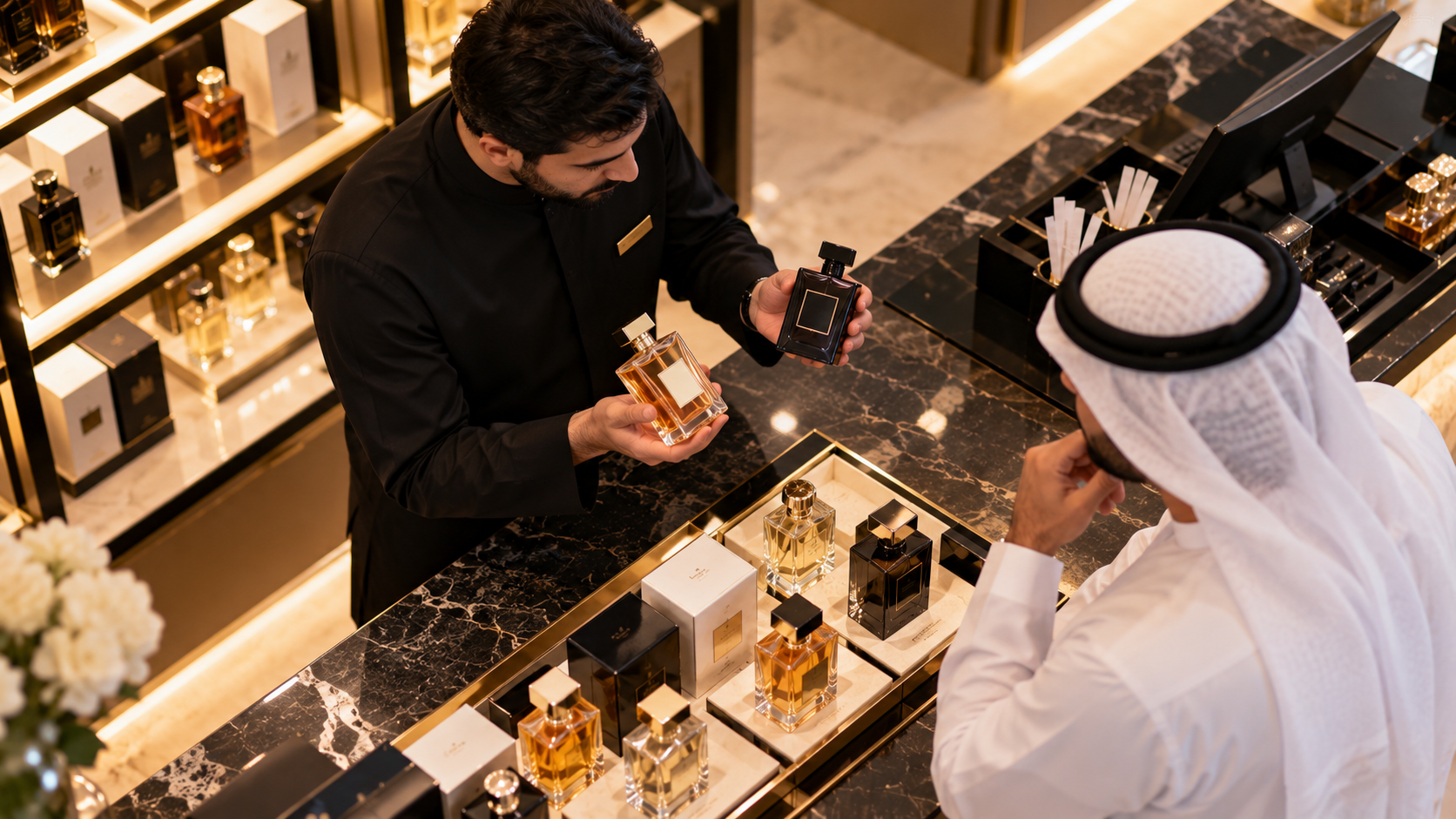
Selling inspired perfumes in the UAE is not an offence in itself: a similar scent alone is not, as a rule, trademark imitation. It becomes imitation and a violation when the trader names the original perfume, shows a picture of its bottle, or advertises the product as the same as the original or the same formula. At that point the owner of the shop or online store is exposed to fines, confiscation of the goods, closure of the shop and a compensation claim, and the matter may end in a criminal complaint.
Many perfume traders believe the risk lies in the product. In practice it usually lies in the way the product is presented and marketed. The fact that the buyer knows the perfume is not the original does not release the trader from liability. This article explains where the line runs between inspired perfumes and counterfeit perfumes, what follows from crossing it, and what to do if you receive a legal notice or a violation.
It is part of our series Intellectual Property and Trademarks in the UAE and is addressed to perfume traders, shop owners and online sellers who want to protect their business before it turns into a case.

Is Selling Inspired Perfumes Legal in the UAE?
As a rule, making a perfume whose scent is close to a famous one and selling it under an independent trade name and different packaging is a lawful activity, provided the licence and product requirements are met. The law protects the trademark, meaning the name, the logo and the distinctive shape. It does not protect the idea of a scent as such.
The Trademarks Law does, however, allow a scent to be registered as a trademark. Where such a registration exists the position changes, and that can only be settled by a search of the trademark register in each case. The practical result: whether selling inspired perfumes in the UAE is legal depends on how they are marketed far more than on how they smell.
When Does Selling Inspired Perfumes Become Trademark Imitation?
The activity becomes a violation when the trader borrows something that belongs to the brand owner in order to sell his own product. These are the four most common forms, in the market and in Instagram and TikTok advertising:
Naming the brand in the advertisement or on the packaging
The owner of a registered trademark may prevent others from using it, or a similar sign, on similar goods where that use is likely to confuse the public. Using the name of a famous perfume to promote another perfume is the clearest example of such confusion, and well-known marks enjoy wider protection.
Showing a picture of the original bottle
The promotional photographs of the original perfume are photographic works protected by the Copyright Law. Copying them from the internet into your store infringes the right of their owner, and it also leads the buyer to believe that the product on offer is the original.
Imitating the shape of the bottle or the packaging
The shape of the bottle may be registered as a three-dimensional trademark or as an industrial design. Details are in our article Industrial Property Rights in the UAE: Legal Protections.
The words «same as the original» or «same formula»
Describing or advertising goods with false or misleading statements is prohibited by the Anti-Commercial Fraud Law and the Consumer Protection Law, and deception as to the composition of goods is an expressly listed form of fraud. The Commercial Transactions Law also treats spreading untrue statements about the characteristics of one's goods as unfair competition giving rise to compensation.
Inspired Perfumes vs Counterfeit Perfumes: What Is the Difference?
Counterfeit perfumes, as defined by the Anti-Commercial Fraud Law, are goods bearing, without permission, a mark identical or similar to a registered trademark. A trader who sells a bottle carrying the brand's name and logo when it does not come from the brand is selling counterfeit goods. That is outside the scope of this article, and the only way to put it right is to stop.
Inspired perfumes carry the trader's own name, mark and packaging. The danger zone lies between the two: a perfume with its own name that is marketed using the name and picture of the original. This is where most perfume traders stand, and where the advertisement, the packaging and the store need legal review before publication, not after the violation.
The Words «Inspired by» Do Not Protect You
Advice circulates online that writing «inspired by» before the name of the original perfume makes an advertisement safe. Most of that advice comes from the rules of other countries, and UAE legislation contains no ready-made wording that grants immunity. The brand name is still being used in the advertisement whatever word comes before it, and what counts is the impression left on the public.
Nor does it help to argue that the customer knows the truth: the Anti-Commercial Fraud Law provides that proving the customer's knowledge does not exempt the supplier from the penalty. No general rule therefore fits every trader, and each advertisement is assessed on its wording, its images and where it is published. That is what a lawyer reviews case by case.
Penalties for Trademark Imitation and Commercial Fraud in the UAE
A single act may breach more than one law at once, so several routes open against the trader:
Trademarks Law
Imprisonment and a fine of AED 100,000 to AED 1,000,000, or either, for anyone who imitates a registered mark in a way that misleads the public or knowingly uses an imitated mark for commercial purposes. Imprisonment for up to one year and a fine of AED 50,000 to AED 200,000, or either, for anyone who knowingly sells or offers for sale goods bearing a mark that is imitated or used without right.
Anti-Commercial Fraud Law
Imprisonment for up to two years and a fine of AED 5,000 to AED 1,000,000, or either, together with confiscation or destruction of the goods and publication of a summary of the judgment at the convicted person's expense, and possible closure of the shop for up to 6 months. The penalty is doubled for a repeat offence.
Consumer Protection Law and Copyright Law
Misleading advertising is punishable by imprisonment for up to two years and a fine of AED 10,000 to AED 2,000,000, or either. Infringing protected works such as photographs is punishable by imprisonment for not less than two months and a fine of AED 10,000 to AED 100,000, or either.
The person in charge of the actual management of a company is personally liable if his knowledge of the violation is proven. Alongside the penalty, the trademark owner may ask the judge of urgent matters to seize the goods and stop their circulation, and may bring a compensation claim before the civil court. These upper limits do not mean every violation ends there: an early defence changes the outcome considerably.
The Perfume Itself May Be Non-Compliant: Perfume Control Rules
A trader may avoid a trademark violation and still commit a product violation. The UAE Scheme for the Control of Perfumes prohibits sales outlets from displaying or selling perfumes unless they are registered under the Emirates Conformity Assessment Scheme or hold a certificate of conformity, and requires the label information on the packaging to be true and substantiated. Anyone who fills or imports perfumes and then sells them under his own name is a supplier bound by these obligations.
Online Stores, Instagram and TikTok Accounts
Selling from a social media account does not take the trader outside the law. The digital trade rules apply, as explained in our article E-commerce through Modern Technology: Organizing Online Stores and Transactions?, and paid promotion is subject to the controls covered in Social Media Advertising and What is an Advertiser Permit?. An online advertisement is easier to prove than a shop sign: one screenshot is enough as evidence, and a complaint from the brand owner may end with the advertisement removed or the account closed.
You Received a Legal Notice from the Brand's Agent or Lawyer: What Now?
A legal notice is not a judgment, but it is the start of a file. How you deal with it in the first days decides whether it ends in a settlement or in a lawsuit and a complaint.
Verify
Check the sender's capacity
Not everyone who sends a notice has the right to send it. The lawyer checks that the mark is registered in the UAE and verifies the capacity of the sender, whether owner or agent. See our article Commercial Agency in UAE: Registration, Termination, and Compensation.
Document
Do not ignore it and do not delete at random
Ignoring the notice is later read as knowledge of the violation and persistence in it. Deleting advertisements without recording what was published may weaken your position when compensation is assessed.
Reply
Do not sign an admission or undertaking on your own
Many notices come with a ready-made undertaking containing an admission of infringement and a compensation amount. Signing it without review turns an arguable dispute into an established debt. The written reply is drafted by the lawyer after assessing the strength of the claim.
Settle
Negotiate from a considered position
In many cases correcting the advertisement and settling costs less than litigation. The firm handles the negotiation and drafts an agreement that closes the file for good and prevents the claim from being renewed.
You Received a Violation or Your Shop Was Closed: Grievance and Settlement
If the competent authority issues a violation, places the goods under seizure or closes the shop, the time limits are short and run from the date of notification. A written grievance may be filed with supporting documents, followed by a challenge before the court if the grievance is rejected. A settlement with the authority may also be requested against an amount it sets, but it is not available to anyone fined in the preceding twelve months, and it does not remove civil liability towards the trademark owner.
Choosing between a grievance and a settlement is a legal decision that affects what comes next. The administrative route is explained in Administrative Issues and Licenses in the UAE. If the matter becomes a criminal complaint, read What to Do If a Complaint Is Filed Against You at Dubai Police? and do not give a statement before consulting a lawyer.
The Safe Route: Your Own Trademark
A trader who builds his sales on someone else's name remains exposed to a claim at any time and owns nothing that protects him. A trader who registers his own trademark owns a commercial asset with real value, and can himself stop others from imitating it. Registration is preceded by a search for similar marks and followed by an opposition period after publication, and any mistake in choosing the name or the class costs a refused application or a later dispute. The procedure is explained in Registering a Trademark in the UAE: Procedures and Protection.
Legal Time Limits Every Perfume Trader Should Know
24 hoursto stop selling the offending goods and withdraw them from the market and warehouses, from receipt of the notice.
10 working daysto apply for a settlement, from the date of notification of the violation and the fine.
10 working daysfor the shop closure decision to be put before the competent court, failing which it is deemed never to have existed.
15 working daysto file a written grievance against the decision with the Minister or the head of the competent authority, from the date of notification.
30 daysto challenge before the competent court after the grievance is rejected or the time for deciding it expires.
Practical Tips for Perfume Shops and Online Stores
Review what is published now
Old advertisements, pinned posts and product pages all count against you, not only the latest advertisement.
Keep your supply documents
The supplier's invoices, the filling contract and the conformity certificates are requested by the regulator, and their absence is a separate violation.
Do not rely on another trader's experience
The fact that someone else publishes the same advertisement without a violation does not make it lawful: a violation usually starts with a complaint from the brand owner.
Take advice before the advertising campaign
A legal review before publication costs far less than a fine, a confiscation or a compensation award after it.
Legal References
Federal Decree-Law No. (36) of 2021 on Trademarks
Cabinet Decision No. (57) of 2022 on the Executive Regulation of the Trademarks Law
Federal Decree-Law No. (42) of 2023 on Combating Commercial Fraud
Cabinet Decision No. (107) of 2026 on the Executive Regulation of the Anti-Commercial Fraud Law
Federal Law No. (15) of 2020 on Consumer Protection, as amended by Federal Decree-Law No. (5) of 2023
Federal Decree-Law No. (38) of 2021 on Copyright and Neighbouring Rights
Federal Law No. (11) of 2021 on the Regulation and Protection of Industrial Property Rights
Federal Decree-Law No. (14) of 2023 on Trading by Modern Technological Means
Federal Decree-Law No. (50) of 2022 promulgating the Commercial Transactions Law
Cabinet Decision No. (5) of 2014 on the UAE Scheme for the Control of Perfumes
Frequently Asked Questions on Selling Inspired and Counterfeit Perfumes in the UAE

Dubai
From its office in Dubai, Awadh Almheiri Law Firm and Legal Consultations provides trademark lawyer services in Dubai for perfume traders, shop owners and online stores: reviewing inspired perfume advertisements, replying to trademark imitation notices, filing grievances against commercial fraud violations, and trademark registration.
Other Emirates
The firm handles cases concerning the sale of counterfeit perfumes, trademark imitation and economic department violations in Abu Dhabi, Sharjah, Ajman, Umm Al Quwain, Ras Al Khaimah and Fujairah, and appears before all courts of the UAE.